Renoviction of the Intellect
On my last visit to the Stabi — pet name for the western branch of Berlin’s state library — I saw an elderly woman wearing a white mink coat and hat. It was like a visitation from another time. The library’s reading rooms, which seem like sets in a work of open theatre, do things like this. One of my favorite characters dresses in smoky black. For months he sat there, scrawling indecipherable wave-form stenography. He’s been gone for a while now.
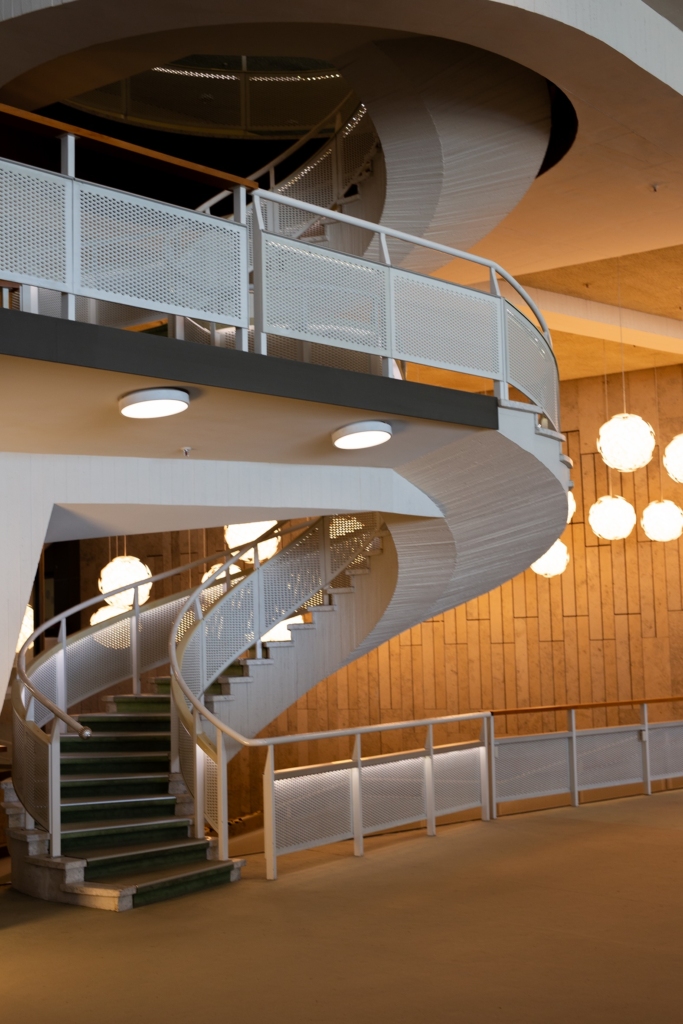
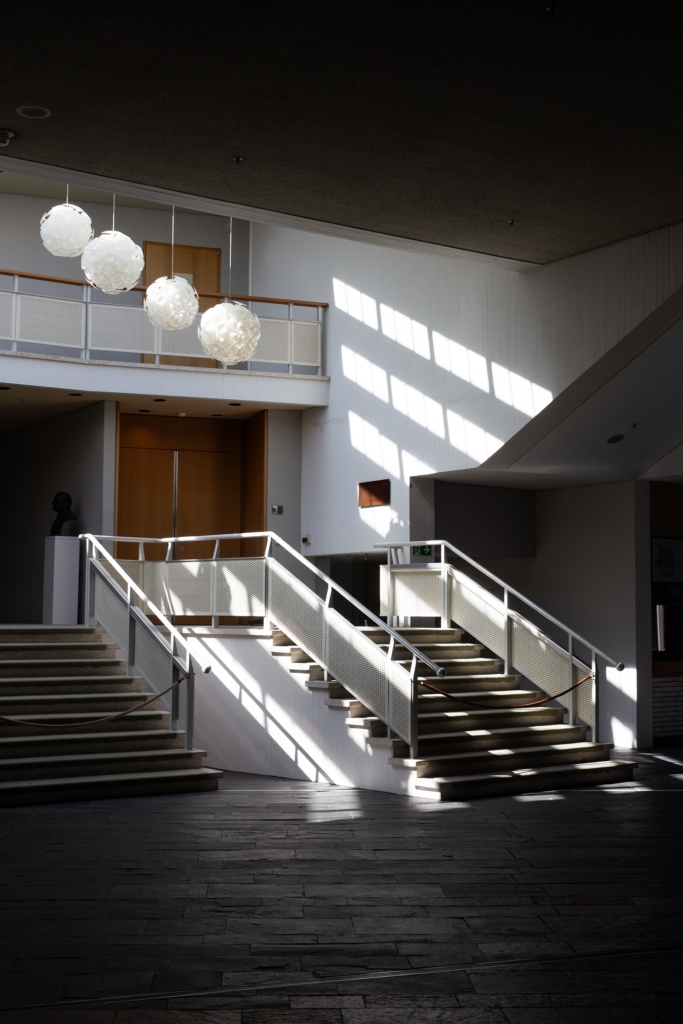
The building, as they say, has character. Its shabby-chic modernism is oddly ravishing. Concrete does things it shouldn’t be able to. One spiral staircase descends like a giant orange peel, through circular cut-outs in overlapping mezzanines; rippling lines evidence the wooden-slat form which — before computerized modeling programs1 — allowed this feat. Details proliferate. Sticking with fruit, how about the banister knobs on the wide entranceway staircase? They look like silver heirloom tomatoes.
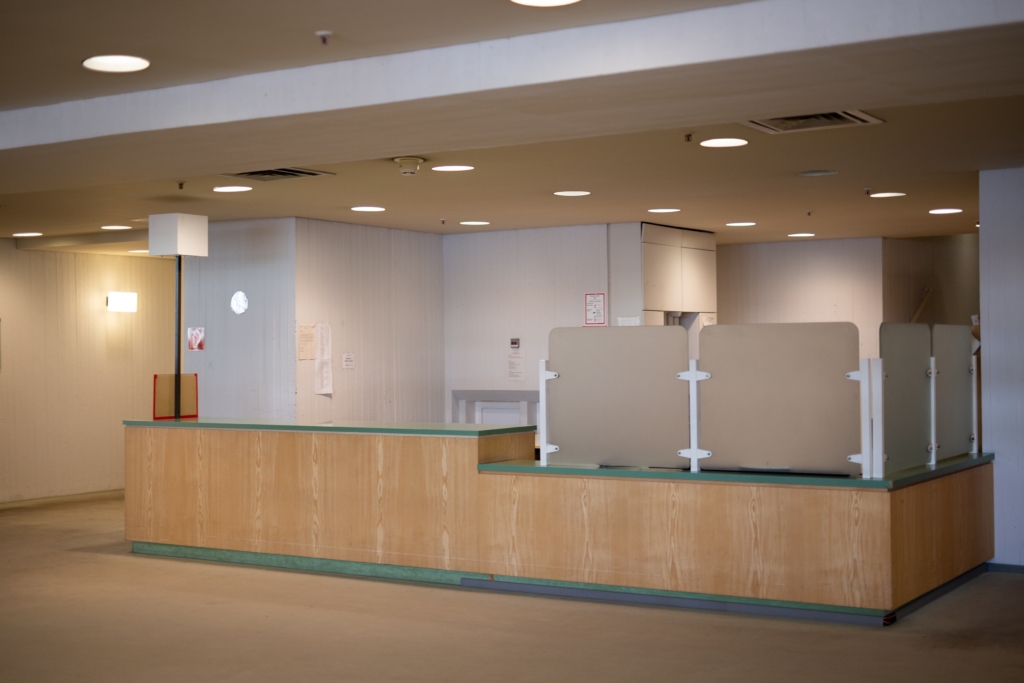
Other details are worrying. Drip stains trace the building’s carpet, which was once pistachio green. Sometimes, a powerful fragrance wafts from the toilets. The smell leaves for a while. Then it’s back!
Yellow tape often bars the washrooms.
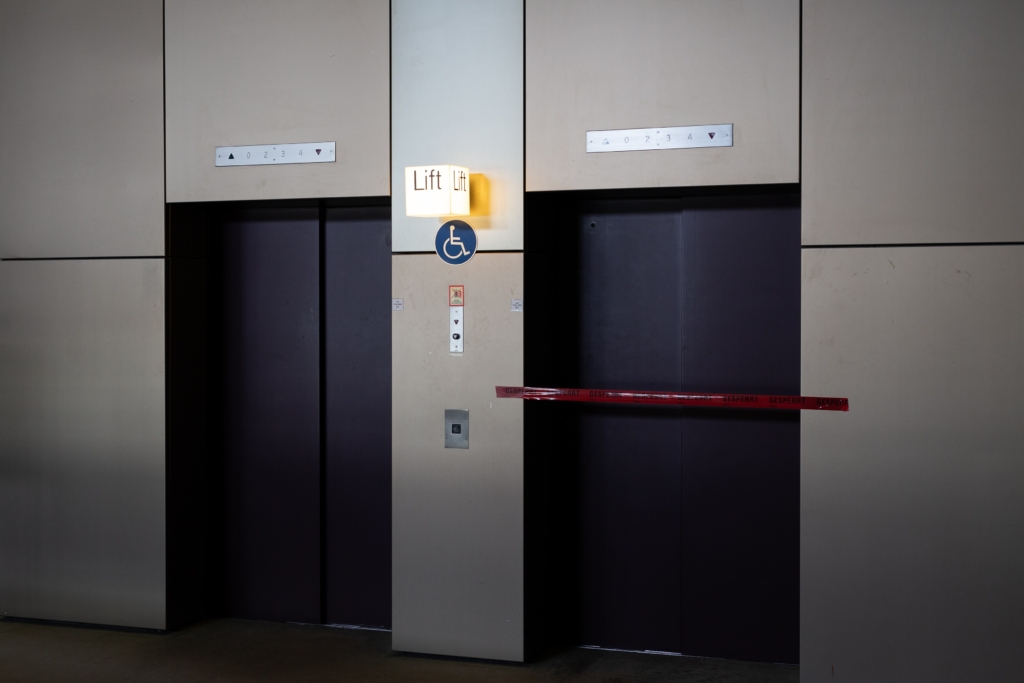
Yellow tape often bars the elevators.
Yellow tape — combined with thick plastic sheeting — often covers the men’s urinals.
Turning on certain bathroom faucets causes others to spew, like a scene from Disney’s Fantasia. Calcium stalactites hang from sink pipes. Fortunately, discourse holds strong. In the bathroom stalls, dialecticians explicate the Middle East: FUCK ISRAEL; FUCK ISRAEL HAMAS.
I’ve neither fucked, nor been fucked by anyone, in the Stabi. But I once met someone who knew someone who had. Rumors of sex in the stacks circulate. And fair enough; so much space, silence, ethereal light, and juicy ornamentation have a way of winding people up. One well-traveled walkway, bisecting the enormous main reading room, forms an unofficial catwalk, for peacocking PhDs, novelists, and students. Clearly, the bathrooms are no place for trysting. Would-be lovers would be better off visiting one of the abandoned control stations. With their disused pneumatic postal tubes, and banks of colorful lights, they look like spaceship consoles in old movies.
Although I don’t have the data in front of me just now, I’d risk a controversial thesis: across its reading rooms and massive lobby, and its corresponding — though unequally distributed — populations of academics, students, unhoused people, librarians, physical laborers, security staff, and gig workers — the Stabi houses a more diverse cross section of life than any other building in Berlin, save hospitals. For all their gorgeous bacchanalia, Berlin’s clubs are restricted by cover charges, unspoken codes, and formidable coolness. Squats are the city’s most radical spaces. But that radicalism, though admirable, disqualifies them from providing a practicable model of pluralistic coexistence.
And so the Stabi emerges as an unlikely candidate for the city’s most socially heterogeneous place. For years, there hasn’t even been a fee. Once, you had to scan your library card at these electronic turnstile devices. Then those devices stopped working. Now they’re also covered with tape.
From 1941 until 1945, millions of the books which now form the Stabi’s holdings waited in a network of mines, monasteries, and castles, along the edges of the German Reich. They had been evacuated from Berlin after Allied bombs hit the Prussian Library, a neoclassical temple on Unter den Linden boulevard. Eight years before, and less than one hundred meters away, Germany’s student union had burned 20,000 books on the grand Bebelplatz, decisively refuting higher education’s prophylactic function against barbarism. Of the evacuated volumes, some 700,000 were lost to the violence and chaos of war.
In 1978, this second branch of Berlin’s national library opened on West Berlin’s Potsdamer Strasse. The building was designed by German architect Hans Scharoun. As a young man, Scharoun’s architecture studies had been interrupted by the First World War. Nearly half a century later, his proposal for the library won a municipal design competition, becoming the cornerstone of the area’s Kulturforum.
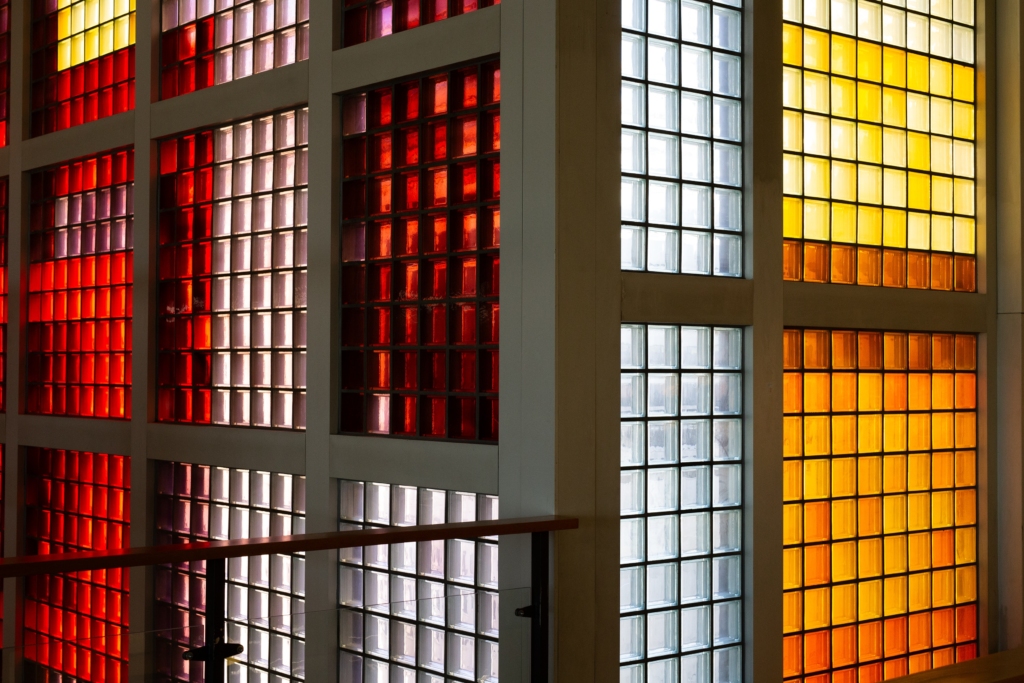
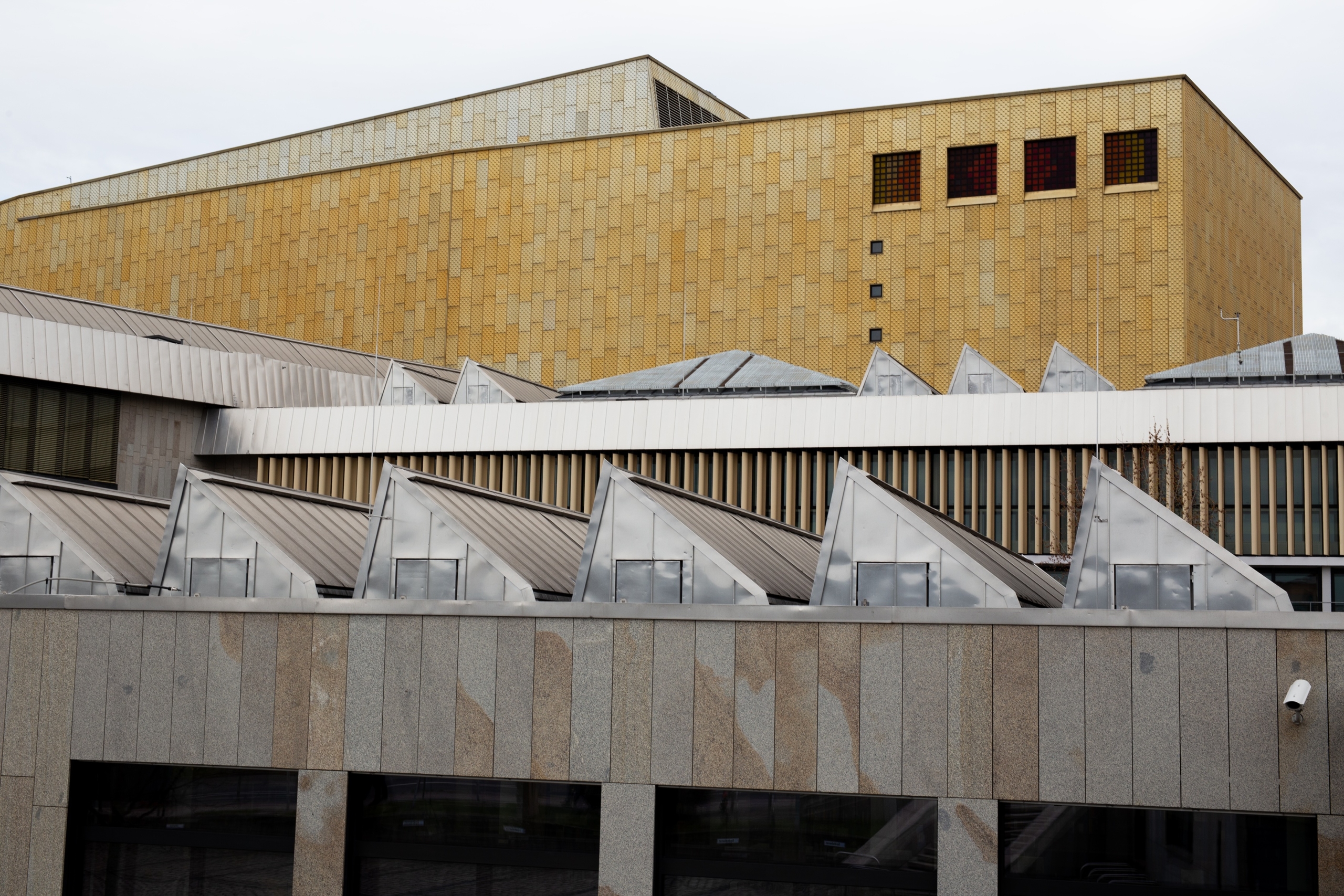
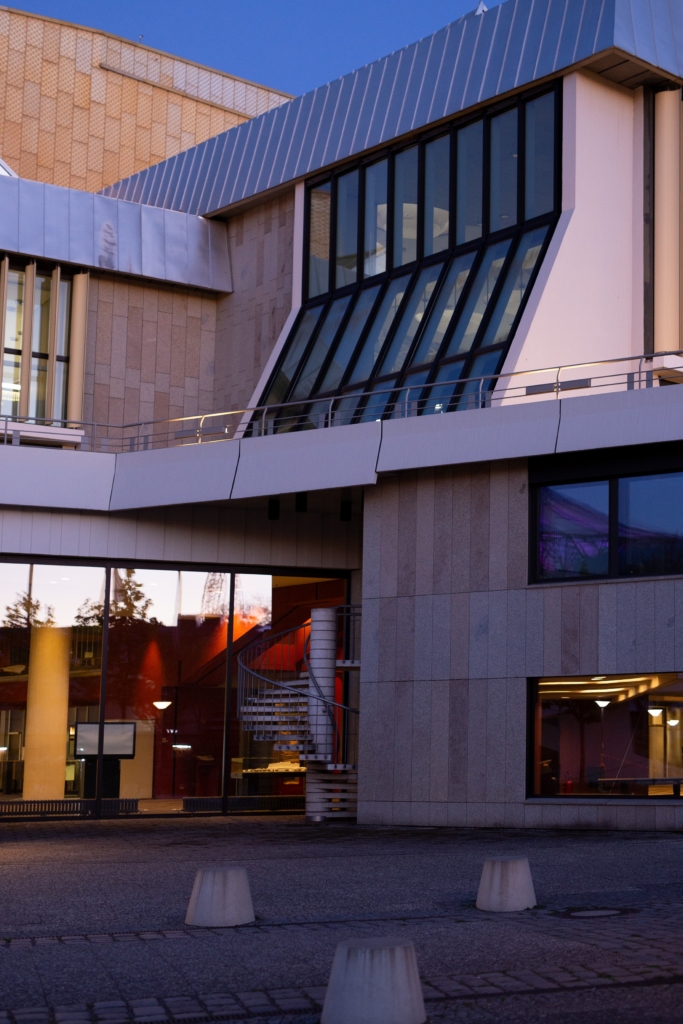
A sprawling flourish of poured concrete and gold-tinted aluminum, Scharoun’s Staatsbibliothek was completed after his passing. Rising over the fallow zone of the former death strip at Potsdamer Platz, and looming over the Berlin Wall, it became home to many of the repatriated books. Now, standing across the street, with your back to the construction site of Berlin’s new Museum of the 20th Century, you can see a golden behemoth rising. The library’s holdings are split between that construction and the basement, originally conceived as a car park. It’s a cliché of Scharoun fandom to observe his nautical influence. But it’s there. This part of the building looks like an enormous ark, albeit punctuated by colored glass bricks. Repeated throughout the building, those bricks infuse peripheral vision with mosaic color. Associations change. Eating lunch on the Stabi’s front lawn, a few days after a new war front opened in Iran, someone said that next year, this building could be a bunker. Actually, someone else replied, it kind of looks like a tank.
It’s damn weird, how enormous things so easily slip from view. Although I’ve spent more hours in the building than I care to count, never have I been interrupted by thoughts of the crushing mass of books overhead. From the Stabi’s front lawn, the golden ark disappears behind palatial windows, and the broad, low entranceway, which bears the library’s name in elegant sans serif, and is forever guarded by smokers: long-coated academics, vested library attendants, and the down-and-out.
PVC plastic plays a central role in the library’s book preservation efforts. For a long time, a coat check offered transparent, disposable plastic totes, which allowed the guards to monitor smugglers of books and destructive substances: pasta with red sauce, marmalade sandwiches, that kind of thing. A few years ago, those bags were discontinued. Now, most visitors use a reusable version, made from thicker plastic. They cost eight euros, via a vending machine in the library’s lobby.
Because I like to save a buck, I used to bring a Ziploc full of peanuts. Indulging a juvenile kink for breaking German rules, I’d ferret these snacks into the reading room, slipping them in my bag, between my laptop and notebook. One afternoon, an unusual blur crossed my eye. My neighbor, an older German man, noticed it too.
“Maus,” he said.
“Maus,” I replied.
For a while, the creature scurried between our legs, charger cables, and a shelf holding the unbearable weight of Heidegger’s Being and Time. Later, in the cafeteria, I discovered a little hole gnawed in my tote.
About a year ago, a meme started going around, describing the gentrification of the Stabi. It struck a note. But in terms of class, the recent arrival of non-academic gig workers in the library runs opposite to gentrification. Many of the new inhabitants are members of the precarious online set. “It’s the cheapest coworking space in Berlin,” I overheard a young man say from behind an enormous black laptop. I winced at this vulgar incursion into the sacred space of the mind. But who could blame workers for colonizing the Stabi, with Berlin’s co-working spaces ballooning in cost, along with that of a cup of coffee, in the city’s hundreds of cafes (the old “cheapest coworking spaces”).
For years, in the Stabi Cafe, a coffee would set you back 1.50 euro. Now it’s holding strong at 2 euros. What does this have to do with freedom? A lot, it turns out, if you’re trying to make ends meet in the new Berlin, the English-nearly-everywhere Berlin, good-luck-finding-a-shared-apartment-bedroom-(or office)-for-under-1000-euros Berlin; if you’re a student scraping by on loans, or a molar-grinding gig-worker clocking hours with keyboard commands and mouse clicks.
In general, there’s little risk of chipping a tooth in the cafeteria. The food is cheap and soft — “prison grade” would be going too far, but not by much. The cafeteria is operated by Sodexo, a conglomerate that also runs penitentiaries. They sell sandwiches which will get you through in a pinch, and an edible mixed green salad, as well as this thing they call pizza, which looks like an old catcher’s mitt, pounded thin, cut square, and sprinkled with canned corn. That said, it was here that I first tasted wild boar stew (Christmas 2019, if memory serves).
The Stabi is a daytime home to the many Berliners whose lives are out of sync with working days. Since the pandemic, the homeless have spread through the sprawling lobby with increasing density, lounging in the ample supply of chairs, charging their phones, and waiting. Others occupy more mysterious realities. One young man stands in doorways and corners, stock still, unblinking eyes conveying permanent fear. For months, I saw an elderly man who wore a cooking pot on his head and pushed a shopping cart, heaped with supplies. Security threw him out. He came back. Now he seems gone for good. On computer terminals, regulars play cards and take care of their business. The library can be a place to release the floodgates of sorrow; one afternoon, while meditating in the half-forgotten poetry section, I was interrupted by a man’s sobbing. As a respite from the loneliness of writing, the library might work a little too well. At a certain point, I noticed years slipping by, as I went there every day, moving words around, speaking to almost no one.
The library has its luminaries. And here a note of regret (or perhaps more accurately put, handwringing). In contrast to the preceding paragraph, the following one is chock full of names. This essay is no exception to a world characterized by specious criteria for according human worth, and even personhood. Paradoxically, through its social mixing function, the library both moves against this broken dimension of the modern human spirit and holds it. History suggests that this effect is not incidental. After the opening of Scharoun’s Berlin Philharmonic — an older sibling to the Stabi, just across Potsdamerstrasse — critics observed a breakdown in the hierarchy between orchestra and audience.
All of which is to say, I became sheepish, upon finding myself fawning over local celebrities: novelist Tom McCarthy, or philosopher Mateo Pasquinelli. On recent visits, I bumped into the novelists Steffi Velasco, and Jan Brandt. While on a DAAD residency from New York, the writer Rajesh Parameswaran spent his afternoons and evenings at the Stabi, before continuing his work at a nearby hotel bar. I sometimes have coffee with Kirsty Bell, whose book The Undercurrents gives the library illuminating treatment. Philosopher Rahel Jaeggi is a regular. One day I’ll come up with a clever question to ask her, or maybe the turtlenecked man who sits at the far end of the reading room, fortified by the collected works of Sigmund Freud, stacked on edge.
Approaching the Stabi after a several-month absence last summer, I noticed a concrete staircase, which had long been hidden by a construction barrier. Looking at its newly-revealed angles, which unfold like the leg of some giant robot, my pulse fluttered. Call it a Pavlovian response to the city under investor onslaught. Here, renovations have become synonymous with profit maximization, and social destruction. It’s enough to make you think that there might be a benevolence to neglect, as long as the rent doesn’t go up. Inside the library, there were more signs of change: A bank of employee desks had been cleared out; a few shelves in the reading room emptied.
Over the years, regulars have been rattled by rumors that the building would close for large-scale renovations. “I might have to leave Berlin,” the writer Alex Cocotas told me, voicing a common sentiment. It’s not too melodramatic to say that the library’s closure, when it comes, will have a permanent effect on lives, and on the city’s cultural and intellectual output.
In 2005, Artforum published an essay about Berlin by the artist Matt Saunders. Accompanying Saunders’ piece was a photo documenting a performance by the artist Mark Wallinger at the Neue Nationalgalerie. Wallinger shuffles through the museum in a bear costume. Here was the city’s spirit animal, entering a sleepwalking hibernation under the snow of late capitalism, which falls heavier and heavier over the city that was once free, or that once allowed us to believe that a city could be. In the image’s background, it is possible to make out the Stabi’s metallic roof, and beneath it, the reading room’s tall glowing panes.
Those windows offer cinematic experiences of snowstorms, sunsets and rain showers. It was there that I happened upon Saunders’ essay, which describes the city’s livability with red-flag magical realism. “The Zeno’s Paradox of Berlin,” Saunders writes, “is that no matter how high [rents] rise, they never quite reach expensive.” Zeno has since left the Hauptstadt and taken his paradox with him. Over the last decade, median asking rent in Berlin has increased by 75 percent; in the last fifteen years, property prices have more than tripled. Living streams of culture have been replaced by tech startups fueled by venture capital.
A few years ago, the sociologist Richard Sennett took the podium at Berlin’s House of World Cultures, in the nearby Tiergarten, to lecture on his philosophy of the open city. For him, just civil space is defined by a freedom of inhabitation and use, inimical to the twin fetishes of real-estate investment and architectural control. Although it is technically a governmental institution, the Stabi, in its current entropic state, is the closest example that Berlin has, of a space amenable to this interhuman civic richness.
Sennett’s conception also suggests that we could have more and different sanctuaries of creative life, if their necessity could be rightly appreciated, and converted into political will. The imagination runs wild: networks of free, open, collective art studios, public access jam studios stocked with keyboards, synthesizers, and drumsets. I seem to have lost my mind. Bad faith economic realism tells us that such humane luxuries are impossible. But bad faith economic realism conveniently forgets about untold sums out of tax coffers, in opaque consulting contracts, the incompetent management of colossal building projects, billions conjured out of the sky for German rearmament, not to mention the intangible costs of reducing life to a profit and loss calculation.
In early 2026, the Stabi’s new renovation dates were announced. They will begin in 2030, take 11 years, and cost 1.1 billion euros (with 350 million euros tacked on for risks and inflation). For Marion Ackermann, president of the Prussian Cultural Heritage Foundation, the renovations are necessary “to make an architectural icon, which is protected as a monument, fit for the future.”
Let’s say that a library can be a monument. During this metaphysical transformation, it doesn’t stop being a library, much less one that is urgently used, now. Eleven years is a long time. Almost one and a half billion Euros is a lot of money. And for what?
The extrication of whichever rotting entity has gotten lost in the plumbing would be welcome. Likewise a leak-proofed ceiling. No one likes cancer, so removing asbestos seems right (although removal operations were already run from 2006-2016, to the tune of around 65 million). The press release mentions requisite upgrades in the name of sustainability. It’s hard to argue with that. But then we’ve got these vanity transformations; the building’s east side will be blown open, to construct a second entranceway (the picture of both good environmental manners, and monument preservation).
There is a sense of visionary disembodiment to the whole thing, and it is creepy. In post-renovation renderings, library users figure as preppy avatars, faces blurred. A piece of pro forma urban renewal blather assures that “current urban planning context” will be accounted for. No less than three times, an announcement discretely hung in the lobby, emphasizes the rehousing of the library’s over 600 staff members. A reasonable person might expect a plan this elaborate to include plans for the people who go there daily to study, write, draft job applications, bide time, crawl towards their doctorates. No such luck. Estimates have the library serving about 3,000 daily users. During exam times, occupancy spikes. Long lines form at the entrance, and visitors can spend hours searching for a spot.
Art historian, previous head of Kunstsammlung Nordrhein Westfalen, former professor at the Munich Academy of Fine Art, Frau Ackermann is no philistine slouch. This is a person who understands culture’s importance. Hence the confusion which arises, in response to the generational shuttering of a building which can be fairly described as a refuge, during a crisis precisely exacerbated by the city’s own decision to savage its budget for subsidized artist studios.
Culture, of course, is made by people, together in free space, meeting, talking, and thinking. The question is not only one of space, in general, but of this space, and this architecture. The Stabi — with its worn-in, un-intimidating café — helps produce a specific and important kind of relationship, in which friendship mixes indistinguishably with critical and artistic matters. Precisely this kind of relationship produced this essay. Multiply that effect exponentially, and you have the living structure of a cultural commons.
“Surely…” I hear myself saying… we can talk this out. Let’s throw a few million at the crucial things. Close the place for two years. Even three. But then do things we actually need. Expand the existing room for parents with children into a functioning daycare. Establish a stipend for low-income writers. Raise wages: for the librarians, the cleaning staff, the cafeteria servers. Ditch the prison profiteers, and do something about the pizza.
In the library’s lobby, a text-based mural reads, “Eins hilft immer: Lesen.” (“One thing always helps — reading”). For many people, so does writing. Off the top of my head, I can count a half dozen novels that are either being written, or which have been recently completed, in the Stabi. This happens because studios are expensive, and writing is lonely. Books will still get drafted during the Stabi’s induced coma. But they will be specific books, written by a specific, more comfortable type of person.
I had this vision, the other day, in which the Stabi joined the ranks of so many great public buildings, felled before their time: amongst them the former East German parliament, another architectural masterwork, its life prematurely ended by the wrecking-ball of Western free-market democracy, its grave now marked by a the city’s new Prussian “Stadtschloss,” a kitsch facsimile of its 15th-century namesake. The Stabi won’t be reduced to a literal rubble pile. But its social and spiritual function in the city may well be. The recently renovated Unter den Linden branch offers a preview. It is a slick affair. An Americano goes for 3.50 euros, and there’s not a homeless person or unemployed online Solitaire player in sight. Palliative reminders that it will remain open during the Stabi’s close neglect to mention that it too is regularly over capacity.
Day in and day out, in this place, you see the same faces. There are people you are fascinated by, and people who, following the opaque mechanics of projection, become objects of disdain. You brush by one another on that wide staircase leading into the reading hall, or in the cafeteria lineup, while you try to decide if this is the day you’ll finally try the Milchreis, or the Bockwurst, that tube of rubbery factory flesh, plated with sliced potatoes in white sauce. Sometimes you want to say hi. Usually you don’t, afraid to trigger never-ending stilted conversations. Instead, you check your phone or shuffle your laptop from one hand to the other. Maybe you look at the moon, glowing on the front of the old cigarette machine. That’s how it goes. People come and go. Distant crushes bloom and fade. The cast changes and doesn’t.
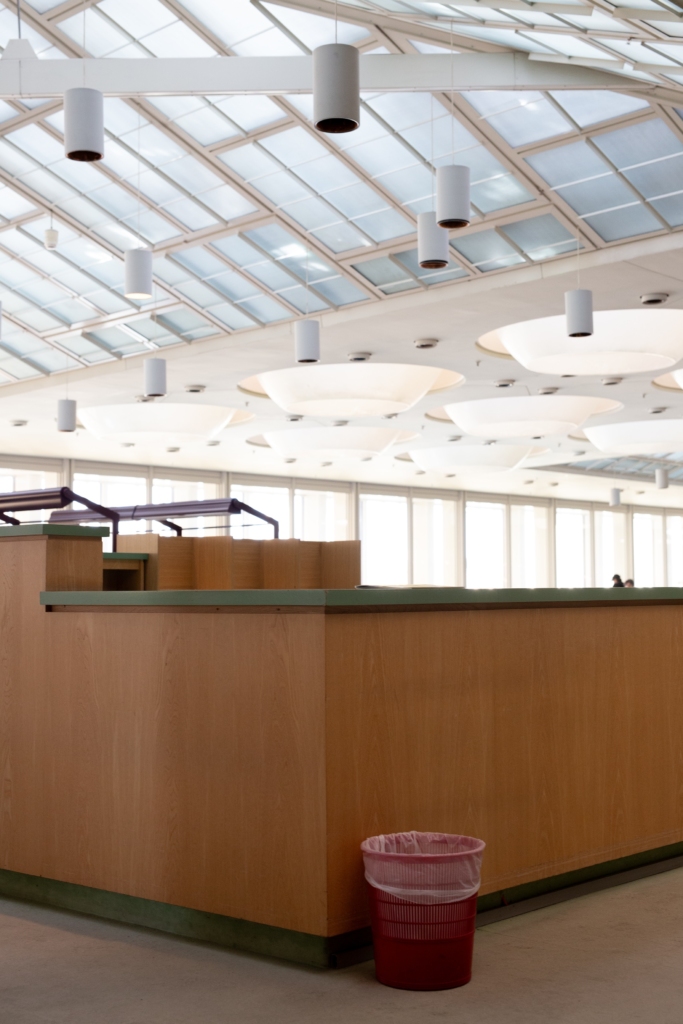
In Stabi lore, a common set piece finds Wim Wenders, in 1986, visiting the building to shoot parts of his classic film Wings of Desire. For its sober appeal to the firmament, Wenders’ German title, Der Himmel Über Berlin — “The Sky Over Berlin” — resonates far more with the city’s strange, twinkling depressivity. In greyscale, the angels walk the aisles. We hear chants and recitations as Bruno Ganz’s Damiel looks over a student’s shoulder. On the desk he finds a copy of Hans Werner Henze’s Opera “Das Ende einer Welt” (“The End of a World”).2 Unless they’ve come straight from Berghain or Golden Gate, brains sizzling with chemicals, it’s unlikely that the people who write in that room will see angels. Instead, looking up, they will take in the building’s iconic ceiling, a gridwork of dome-shaped fiberglass skylights, which look like huge pearls.
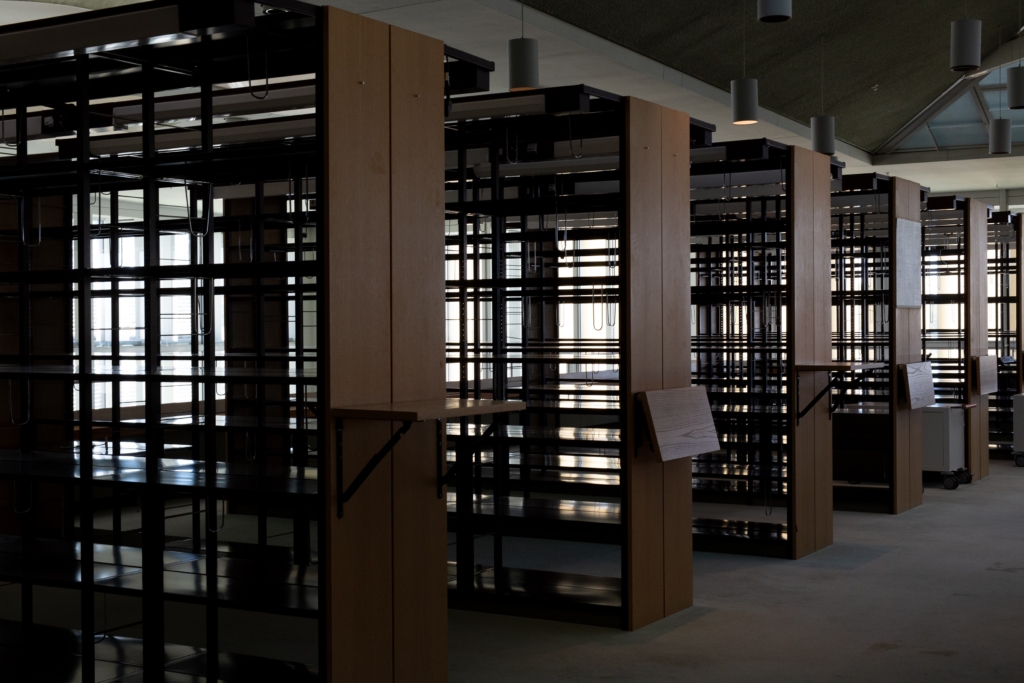
Sit in the reading rooms long enough, and you may start to hear gasping sounds. This is the sound of forced respiration — the autonomic nervous system forcing air in and out of breathless, hyper-focused and over-caffeinated bodies. For voluntary breathers like myself, the effect can be grating. Seeking relief, I sometimes leave my desk, wonderfully aged merlot-and-gray, and examine faded book spines. There are records of books which record municipal decisions, celebrity names, science fiction films made in the DDR, and people who aren’t famous but should’ve been. There are books which record books which are records of things.
A few months ago, another unnerving sound started coming from one of those orbs on high. Several of us looked up, trying to find its source. The squealing and squawking suggested a struggling bird. But although previous pigeon sightings supported this hunch, something about the sounds didn’t. They were too consistent. Probably, we seemed to realize together, it was just an electrical malfunction. A dying electrical ballast, maybe. It wouldn’t have been the first time. We exchanged glances and shrugs. Then all you heard was keystrokes, muffled coughs, and the click of microfilm.