Impolite Bodies
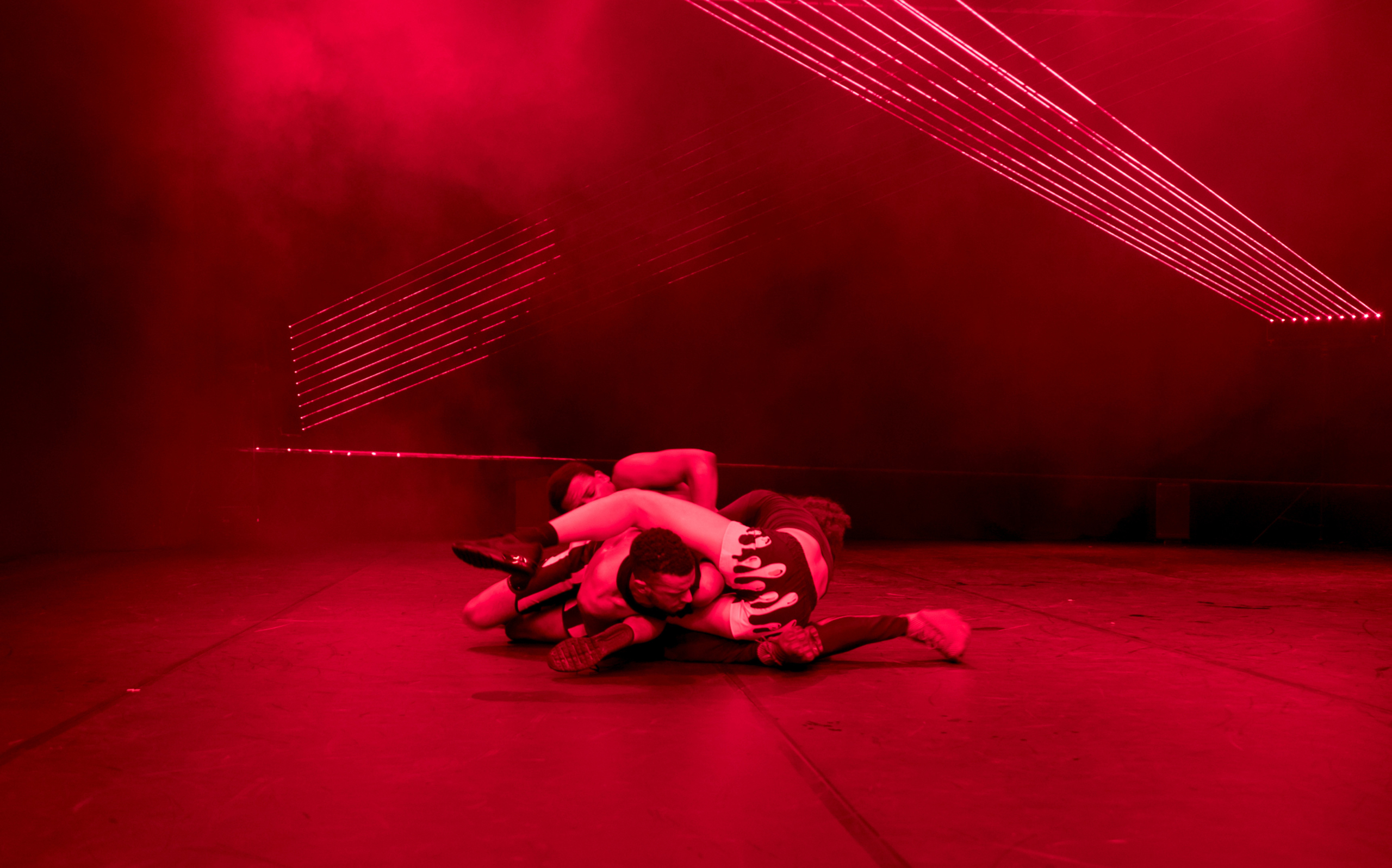
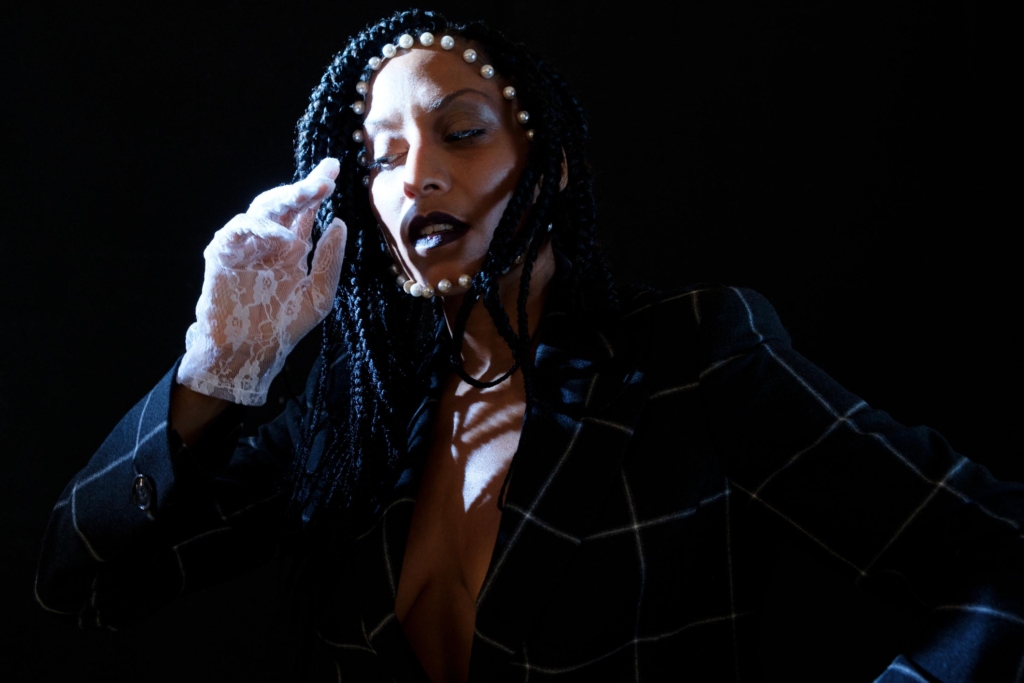
There is sarcasm, and there is deadpan; when delivered and received appropriately, both can leave the intended audience in a jocular terrain. But on occasion, when the joke hits a cultural dead end, or is interrupted by an observer, it can leave someone suddenly feeling unsettled. Most performers worry about this risk, but for the Berlin-based artist Ligia Lewis, that state of uncertainty is welcome. Lewis excels as a choreographer, dancer, and director; she channels satire through hyperbolic bodily gestures and tragedy as she engages with tenebrous episodes of history on stage and in film. Most recently, a catalogue of her work was exhibited at Berlin’s Gropius Bau.
If, as American choreographer Martha Graham posited, “Dance is the hidden language of the soul of the body,” then Lewis meticulously articulates the intimate marriage between spirit and figure. Since moving to Berlin in 2013, she has developed a dance practice that conveys fugitive choreography through exaggerated and subtle facial expressions and bodily movements. She animates present and past dystopias through a rotating set of characters, illuminating unruly layers of play.
Lewis has presented her genre-defying oeuvre across the globe: at MOCA in Los Angeles, the Tate in London, the Liverpool Biennale, Wien Modern, HAU Hebbel am Ufer, and other institutions. Between 2014 and 2018, she composed a trilogy for dance, Sorrow Song (2014), minor matter (2016), and Water Will (in Melody) (2018). Each of these pieces engages with the familiar — the American hues of blue, red, and white — and the less visible — the recurring cycles of racialized death in America. For the 2020 Made in L.A. show at the UCLA Hammer Museum, Lewis has conceived and directed deader than dead, in which she employs impassive mannerisms through comedic distance. Here, the performers lament, twitch, and endeavor to resist flatness. Her idiosyncratic style has earned her the distinctions of the Tabori Award in the category of Distinction, a Foundation for Contemporary Arts Grants Award, and a Bessie Award for Outstanding Production.
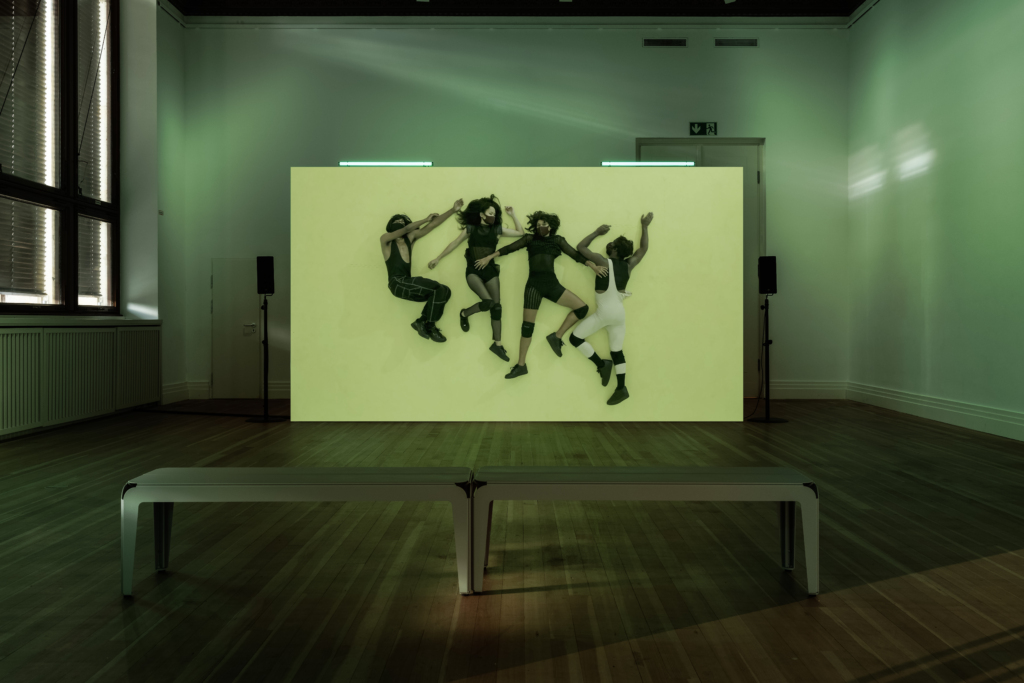
I interviewed Lewis on a glacial day in December 2025, sitting in the atrium of the Gropius Bau. We settled in on one of the several cushions that were laid out for visitors to read texts that Lewis gathered, a marker that even in this spare space, we were within the confines of her exhibition, I’M NOT HERE FORRRRR…. As grayish sun filtered through the room, the bit of lightness seemed to contrast with the dark carpet beneath us. As we sat, we could hear the shrill cries of toddlers in one of the exhibition rooms. Midway through our conversation, three of her collaborators emerged from backstage to perform live. As they passed by, her eyes flickered with glee.
Over the years, Lewis has evolved her practice, and each time she develops a new piece she deploys her acuity with subtlety, through the technical act of the everyday, through speech melody that echoes the composer Arnold Schoenberg’s Pierrot Lunaire, and through a nonchalant flow that embodies the filmmaker Maya Deren’s grace. Lewis’s sober enthusiasm is infectious, especially when pronounced with the weight of her philosophical inquiry.
– Edna Bonhomme
Edna Bonhomme: When and why did you move to Berlin, and why did you decide to move here?
Ligia Lewis: I first moved here in 2007. Not for any special reason, really. My oldest sister, who had a German boyfriend at the time, was living here. I was already fascinated by what felt like a growing art scene. It was clear that Germany didn’t know what to do with me at that time, so I kept returning to the United States.
My career has been unpredictable, and it still surprises me how things unfold in Germany and in my life. The early stages of my works, like “Sorrow Swag” and “minor matter,” were developed in Los Angeles. At that point, curators in Berlin were starting to recognize my work. But I wouldn’t have been able to rely on living in Berlin solely to create “minor matter” because the conversations I needed to have were happening in America. Over time, Germany has tended to adopt aspects of my work, often claiming it as their own only after they’ve seen it elsewhere, but that’s just how it goes.
I don’t intend to be polite. This is, potentially and sadly, often missed in a country like Germany, where the aesthetic can somehow miraculously be divorced from the political.
EB: What does it mean for them to want you suddenly? What aspect of your work are people in a German or Berlin context attracted to? Is it the content, the style, or the aesthetic elements of what you’re producing?
LL: Honestly, I never really know. They don’t fully understand what I’m doing. I’ve developed a specific aesthetic language and signature in my work. Still, the questions I’m exploring in my art always seem to shift according to the context in which it is made, rather than towards a gentle, non-threatening desire for representation. Quite the contrary. My work threatens the current order of things. I don’t intend to be polite. This is, potentially and sadly, often missed in a country like Germany, where the aesthetic can somehow miraculously be divorced from the political. And for me, this is a huge problem. They perceive a desire for representation rather than questioning it at its root or understanding the demand and need behind it. More specifically, I think their aesthetic regime is so deeply embedded and racialized, yet most Germans can’t even see it. When they see my work, I feel like they sense something they can’t quite name. Many white Europeans seem curious, but I’m not sure they truly engage.
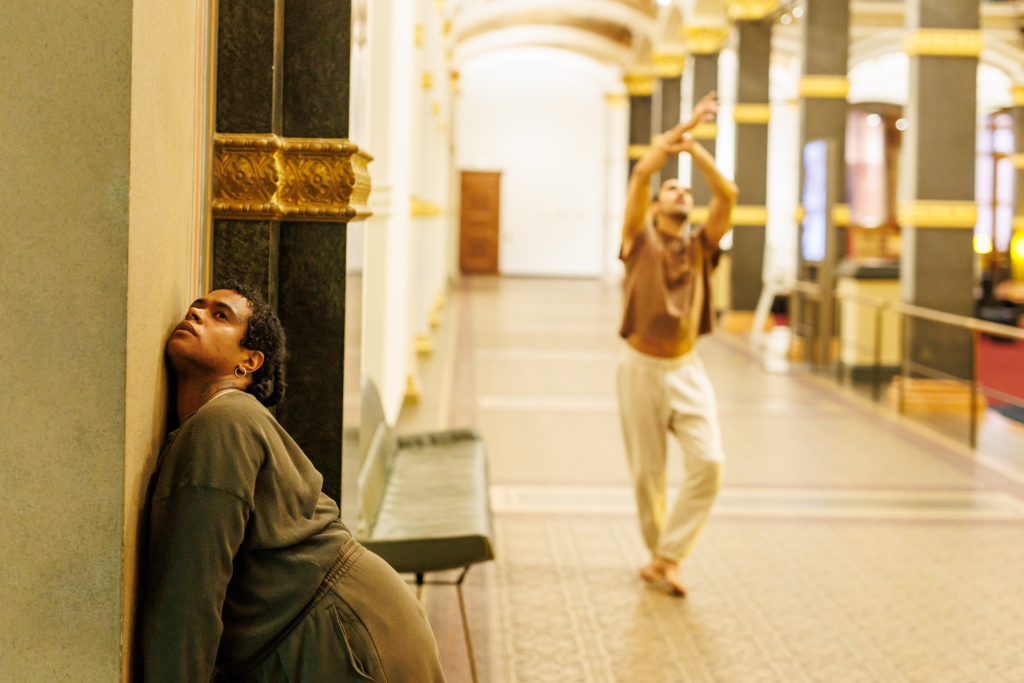
EB: Your work is theoretically grounded. I see echoes of Fred Moten’s Blackness and Nothingness, Saidiya Hartman’s notion of critical fabulation, and David Marriott’s “corpsing.” In particular, “corpsing,” a theater term for unintentional laughter at a noncomedic moment, is associated with a performer exceeding the limits of theater and losing command of a role.
LL: Absolutely. What you’re pointing out is that David Marriott is a total threat to the entire infrastructure of the aesthetic regime and its history; he completely uproots it. Marriott explores, among other things, how the aesthetic is bound to the abjection of black flesh and, for that matter, black life, which allows for a fetishistic relation rather than one that permits an actual witnessing of blackness outside of a violent gaze. And it is within this regime that Black erasure remains cyclical, a constant thread within museum logic. I mention Marriott out of respect for his work, as well as the other scholars you mentioned — as I feel they remind me of the nuances of Black representation and why to avoid this nineties-style representational gesture that seems so desired here in Europe, though that too is fleeting.
My work explores the idea that every time a Black person enters a museum, it’s treated as if it’s the first time, which is overwhelming and tragic.
I’ve continually developed my work out of my own curiosity, knowing I’m mostly presenting to my own audience. But it continues to provoke my thinking about how to present, while remaining cautious toward earlier, simplistic representational models that trap blackness in and through reduction and commodity… which is to say, making my work has been and remains a tremendous challenge.
I need to remain in a space of embodied critique as much as in one of embodied exploration. Those two things have to go together because the white gaze is so overwhelming in Europe. As is the fetishization of blackness. My work explores the idea that every time a Black person enters a museum, it’s treated as if it’s the first time, which is overwhelming and tragic.
I’ve worked with multiracial casts because I thought, “Okay, race matters.” My entire trilogy reflects this most explicitly, and the later stage work “Still Not Still” drives the point home in the most succinct manner. To counterbalance the focus on literal flesh, I had to organize the gaze in a way that offset the intense demands placed on black artists to overturn centuries of abjection, while simultaneously exposing the pernicious matrix of power that all bodies navigate across race and gender… In “A Plot / A Scandal,” I worked explicitly on the logic of racial capitalism. Using historical materials such as the slave law Code Noir and the European liberal doctrine of man’s rights to life, liberty, and property, I examined how the notion of property renders black flesh vulnerable and unworthy, while simultaneously making it available to be consumed or manipulated (plasticized), as Zakkiyah Iman Jackson describes it, yet without value from within. How can I even map out the coordinates of my own liberation, let alone my ancestral ties to spiritual practice, without talking about how deeply the aesthetic values of the European art world are embedded in violence?
EB: You described the performance as potentially involving precarity that can exist on stage or in a theater, but it could also be seen as improvisation and the ability to adapt, especially if you’ve performed many times and perhaps enhanced the aesthetics of the performance.
LL: The beauty of having a job that involves presentations on multiple occasions is that you’re constantly developing the work. I am honing each work each time it meets a public. I’m mostly drawn to the sonic resonance of a work and how it feels to both perform and watch. So this part of my practice sharpens and continues to evolve. That includes playing with the materialities of the body, for example, the sound of a shoe shuffling across the floor, the sound of the breath, the sound of skin hitting the carpet, the sound of being emotionally over something, and, of course, meeting a soundscape full of historical and conceptual references.
When I’m composing or writing text, I’m often concerned with its sound and what the words feel like as they are uttered, more like a lyric. I also think about the piece’s musical style and how that might transport an audience to a productive elsewhere that allows us to see more of what is in front of us. So I ask myself what sonic landscape is needed to express these ideas across these bodies? And therefore, speech, sung or spoken, is very important in my work because it’s also a way to give performers some more agency. The stuttering of words, or the sounds of bodies wrestling with an amalgam of physicalities, makes the moments of silence within each work an important texture, a space to see or witness.
A lot of my work uses the materiality of the body very literally. Instead of focusing on the psychological space through a traditional approach to melodrama — I am thinking more in terms of an interior mode of representing emotion — I’m interested in how you can make the process of thought resonant, processual, and allow it to be exposed and looked at. How to turn thought into a sound? We often stay on the surface of expression, which is deceptively light and playful, but over time the weight of the gestures performed appears. We’re constantly using our bodies to create sound to achieve the work’s dramatic effect, and the audience is very much invited to witness that process. The processual nature of my work is integral to how I work and how I want audiences to encounter it.
I’m dealing quite explicitly with the critique of black erasure — the ghosting of blackness. The piece allows the ghosts to speak.
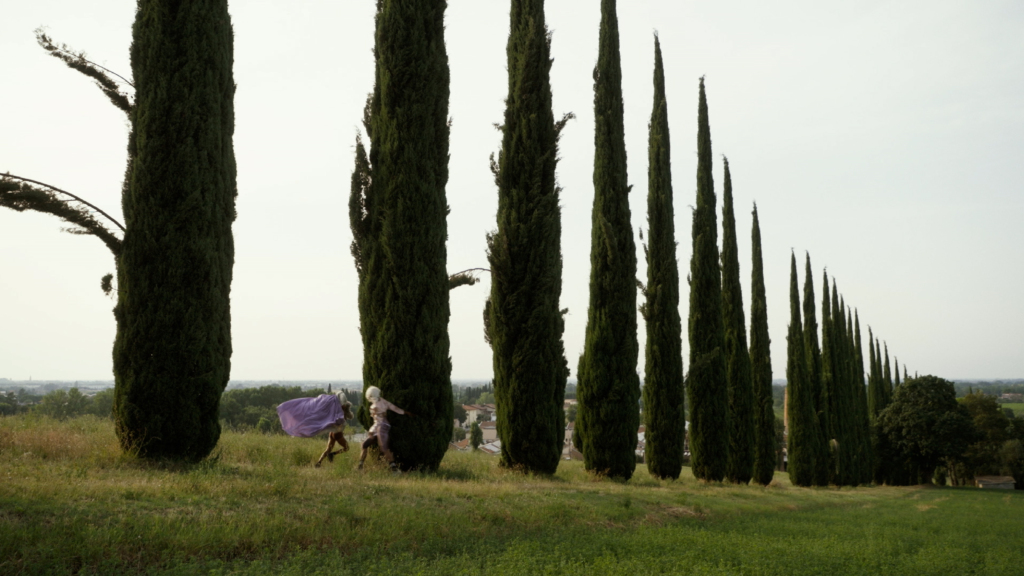
EB: During the opening of “Wayward Chant (Prelude),” a chorus presents a blues-like melodic sound and recursive movements. In the vocal incantations, performers assemble, collide, and explore. At one point, you shift your gaze from yourself to the audience. Why did you choose to do this?
LL: I choose to gaze at the audience playfully. The effect almost becomes a form of bodily plasticity. It’s stretched. I work with the affect of “I just can’t with you,” and then I sing with that voice. That’s an affective mode, heavy-footed, which is the wayward chant. It’s also the rant that just can’t — which frames the entire piece. And everything’s heavy-footed. The audience can hear everything; they can listen to the body’s “mm-hmm” across the space alongside these chants/rants that I wrote — “I am not here forrrrrr…, I was never here though, the conditions of me goooo, all the way back forrrrrr… But I was never here though… I was never here though…”
I’m dealing quite explicitly with the critique of black erasure — the ghosting of blackness. The piece allows the ghosts to speak.
EB: Do you think this also relates to what you said earlier, when you suggested there’s a form of necrophilia within the European context, where, among some white people, much of it is connected to a particular way that blackness can be commodified as entertainment?
LL: Absolutely. The expectation to entertain the audience, particularly as black folks, is overwhelming and frustrating. In my work, I make use of a mimetic quality of performance, and in these later works, including “Wayward Chant,” the physicality of “corpsing.” This produces a kind of haunted space, mixed with the soundscape and the chorus. All of these expressions are interesting to me because they lend the bodies a heightened performativity, mixed with a sort of deadpan. This creates an interesting tension as it is witnessed. The exhibition, “I’M NOT HERE FORRRRR…,” is so literal that it’s almost hyperbole. It was so much fun for all of us to be with each other, because it was also, strangely, heavy-footed, which gave us a bit of breath, despite the institutional fuck-ups, which were many. Naming the exhaustion of being here and the performed reminder that the work has yet to really begin within these frameworks allows for a bit of humor and a bit of play to appear, even if only for us to enjoy.