Suffering the Text
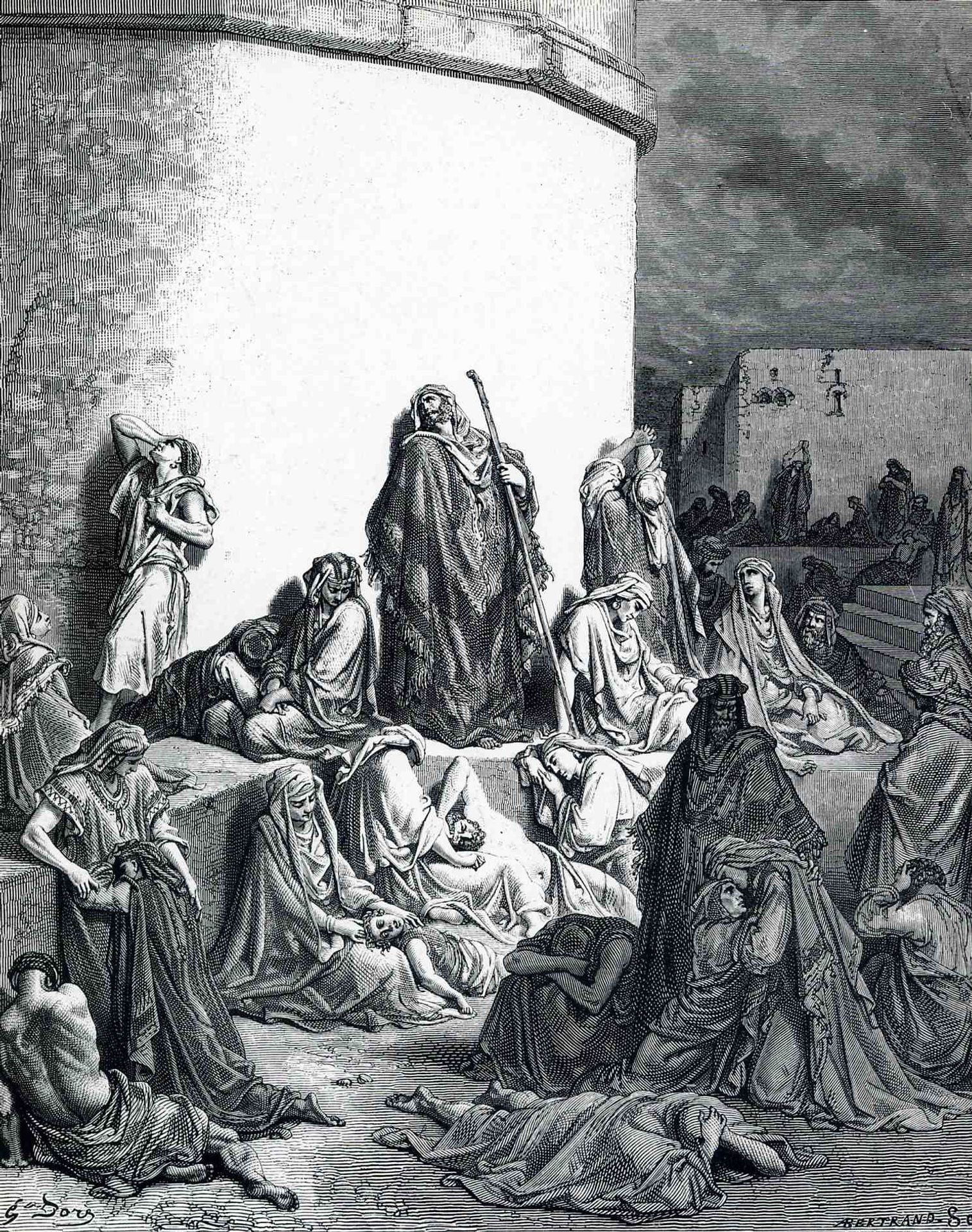
At a Jewish-led protest against the genocide in Gaza, a speaker climbs onto a folding chair and chants the opening of Eikha — the Book of Lamentations read each year on Tisha B’Av, the day commemorating the major disasters of the Jewish people. “How lonely sits the city that was full of people!” The crowd murmurs along. The parallel comes quickly: Jerusalem destroyed by the Babylonians, Gaza destroyed by the Israeli army. The mothers in mourning, homes reduced to rubble, a city emptied of its children. We know this pain, the speaker says. Tisha B’Av is a mirror for the Palestinian genocide. It is moving. It’s supposed to be. But I feel a knot in my stomach.
I know these verses. They don’t end as a universal lament. They end in longing for return — for the Temple rebuilt, for Jewish sovereignty restored. In the Tisha B’Av liturgy, exile is not a shared condition; it is a wound to be healed by coming home and rebuilding the walls. Not a call for open borders, it dreams of our own fortress.
Eikha is, before anything else, a text of devastation. Its verses linger over starvation, ruined walls, and the humiliation of a conquered city. I can understand the urge to form an analogy with Gaza. Eikha can sound like a lament for any destroyed city, a portable grammar of mourning and solidarity. But the grief is not abstract or universal, it belongs to a “we,” the “we” of Biblical Jerusalem and the Temple. The loss is covenantal, and the imagined repair is, too. The book’s final plea — “Turn us back to You, O Lord, and we will return; renew our days as of old” (5:21) — is a spiritual request bound up with political geography. In biblical theology, to be restored to God is to be restored to the land, the Temple, and collective sovereignty. This intertwining of mourning with the hope of renewal has, across centuries, made Eikha a natural resource for restorationist readings. It’s this tether — between loss and return — that makes the text impossible for me to read as a universal lament alone.
I cannot make Eikha say “Free Gaza.” I can only suffer it.
In the diasporic Jewish spaces I’ve been in since October 7 — in Germany and the U.S. — this kind of reading is common: take a Jewish text, sand off the edges, bend it until it affirms our current politics. The effect is a textual homecoming: the pleasure of finding the Jewish textual tradition already on your side. Roland Barthes, in The Pleasure of the Text, names this plaisir: the unambiguous satisfaction of recognizing yourself in the text, feeling the warmth of its affirmation. He sets it against jouissance (bliss), those moments when a text resists, unsettles, and refuses one’s desires. In the square, plaisir can slide into denial: the refusal to let the tradition speak its more troubling truths. Pleasure is frictionless and reassuring; bliss is risky.
At these protests, and in essays published since October 2023, I’ve been watching pleasure at work — diasporic pleasure — the joy of discovering that our reading can harmonize Jewish memory with anti-genocide politics. But my reading, shaped by growing up in Israel, doesn’t grant that harmony. My Judaism was braided with nationalism from the start. Eikha was taught to me as proof of God’s promise to restore one destroyed city, not all cities. The political DNA of return (restoration, a sovereign center) sits inside the text and inside me. I cannot strip it out. For me, the text offers no pleasure, only resistance. Just what Barthes might call bliss, though in my case it feels more like abrasion. The text does not yield. It insists on its own history, its own politics. It keeps me from pretending that the text, deep down, has always agreed with me. I cannot make Eikha say “Free Gaza.” I can only suffer it.
Opening the Text
What I’ve seen with Eikha is only one instance of a much wider habit in Jewish leftist political spaces. In protests and on progressive Jewish platforms, there’s a recurring move: declare that Zionism is a misreading of Jewish scripture, that the tradition is inherently diasporic, essentially universalist, and that its “true” message is tikkun olam — “repair of the world.” This is a reassuring story. It allows us to imagine Jewish textuality as a long, unbroken chain of anti-oppression ethics, a heritage that was only recently hijacked by nationalism.
To suffer a text is to remain in relationship without reconciliation — to let it wound you, and to resist the reflex to remake it in your own image.
But this mode of reading comes at a cost. It flattens Jewish textual history into a single moral register, scrubbing away the parts that don’t fit. The same Torah that commands care for the stranger also commands conquest of the land: “When the Lord your God brings you into the land… you must doom them to destruction. Make no covenant with them and show them no mercy” (Deuteronomy 7:1–2). The biblical ethic is often inseparable from the project of taking, holding, and purifying a territory. Even our most lyrical laments can carry the same restorationist core. Psalm 137, sung in exile, begins with the image of a people weeping by the rivers of Babylon, swearing never to forget Jerusalem. It ends with the fantasy of a grotesque wish of return: “Happy is the one who seizes your infants and dashes them against the rocks.” The longing for return here is inseparable from the desire to punish those who displaced us or currently inhabit our land. These examples are not marginal oddities. They show how easily a moral vision and a politics of exclusion can inhabit the same verse. To reduce all of this to tikkun olam is to turn a contradictory, multivocal tradition into a safe brand and to erase the parts of our inheritance that have been, and still are, mobilized toward violence.
By suffering the text I don’t mean a pious masochism. I mean a refusal to overwrite what’s there. To suffer a text is to remain in relationship without reconciliation — to let it wound you, and to resist the reflex to remake it in your own image. To suffer the text is to refuse appropriation (I won’t take the text hostage to my politics. If it doesn’t say what I want, I won’t pretend it does), to refuse erasure (I won’t claim the tradition has always already been a liberation theology), to refuse comfort (I won’t pretend to a clean inheritance when the record is tangled with conquest).
The openness of the text does not absolve us from its alterity. It obliges us to meet the text’s many voices — including the ones hostile to ours — without collapsing them into our preferences. Barthes writes, “the text is a fetish object, and this fetish desires me.” In a diasporic mode of pleasure, the fetish seems to love you back, gently. In my reading, the fetish wants something I cannot give. In that mismatch, I find responsibility, not reconciliation.
So perhaps the work now is not to insist our tradition has always been progressive, not to smooth its edges, but to sit with the friction — to let the violence, exceptionalism, isolationism, and restorationist longing remain visible, and then decide, deliberately, what we will refuse to carry forward.
Finding Tradition
This stance is not foreign to Jewish textuality. The tradition has long preserved what it finds difficult. The Talmud often keeps rejected rulings inside the canon, sometimes marking them with lo kakh haya ma’aseh — “it did not happen that way” — but refusing to erase them. Medieval commentators will sometimes leave verses labeled kasheh — “hard,” “difficult” — without resolution. Midrash multiplies conflicting readings rather than harmonizing them, and the literature of protest — Abraham arguing with God, Moses demanding mercy, Job refusing pious explanations — models a relationship to the sacred that doesn’t require agreement to sustain intimacy. We have frameworks for living with texts that wound and for keeping that wound visible.
Suffering the text, then, is not abandonment. It is a form of fidelity that refuses to make the tradition harmless. It treats the canon not as a mirror but as an adversary we cannot disown. It honors the record by letting it speak in registers we may reject — and it honors our politics by not outsourcing our commitments to a curated past.
In a moment when language of return and divine promise is weaponized to defend mass killing, ethnic cleansing, and occupation, our work is not to sand the textual edges down but to feel their sharpness.
Suffering the text is choosing when not to cite scripture — and being honest when we do. If a verse lends clarity to our present grief, say so; if it drags us back toward fortress dreams, say that too. In study, it means teaching Eikha as a text that desires return while insisting that our ethics today cannot be built on the promise of rebuilt walls. If “return” is deployed to justify dispossession, the ethical task is to oppose dispossession — not to locate a counter-verse that flatters us. The point of reading is not to recruit scripture as a spokesperson, but to become more exacting about what we accept and what we refuse.
To suffer the text is not to give up on Jewish tradition. It is to decline to make it easy. In a moment when language of return and divine promise is weaponized to defend mass killing, ethnic cleansing, and occupation, our work is not to sand the textual edges down but to feel their sharpness. Suffering the text keeps us honest. It reminds us that solidarity is not built on pretending our inheritance has always been pure, but on confronting what in it must be resisted — and choosing, in full view of its violence, to act otherwise.
If pleasure sometimes offers a homecoming, suffering readers will never get that homecoming back. What we can have, instead, is clarity: a practice of reading that accepts the text’s power to wound and refuses to pass the wound along. It is a way of staying, inside the tradition, inside political responsibility, without lying about either.