One Night at BURG
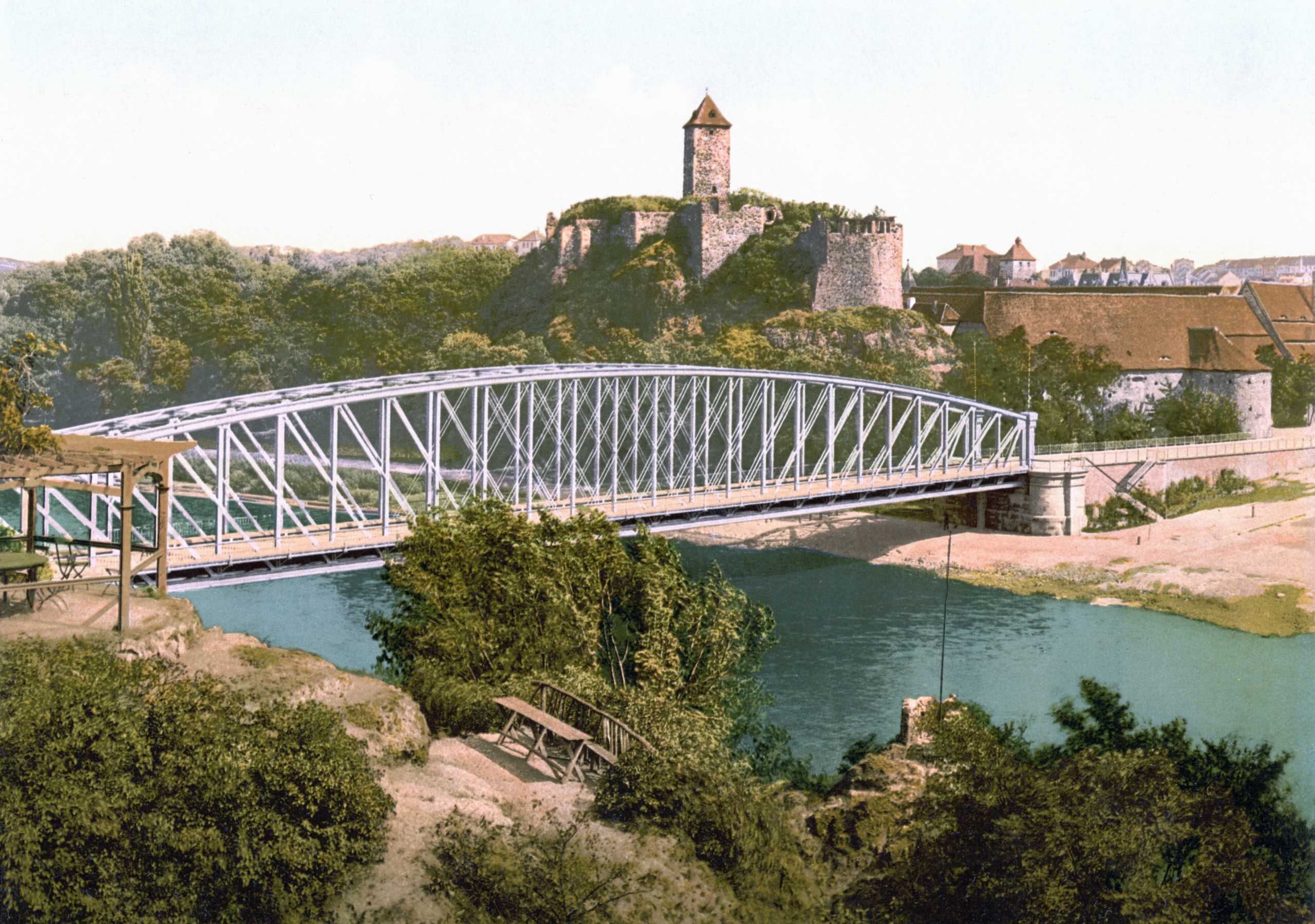
It was a summer afternoon in mid-July of 2024. On the campus of the Burg Giebichenstein University of Art and Design (BURG) in Halle an der Saale, a crowd had gathered for the annual exhibition, the biggest event of the academic year.
Among them was a 29-year-old named Farouk1, whose partner was studying at BURG at the time. Farouk grew up in Rhineland-Palatinate, but his father is from Tunisia, and Farouk sees himself as part of the Tunisian diaspora. That evening, over his shoulders, he wore a keffiyeh — probably the best-known sartorial symbol of solidarity with Palestine.
That night, music was filling the air as students milled around between art and fashion studios. Then, Farouk was attacked. A bald man carrying weighted-knuckle gloves in his pants pocket ripped the keffiyeh from Farouk’s shoulders and punched him in the face.
“He just came out of nowhere,” Farouk told the Diasporist. Another attendee rushed over, wrestled the attacker to the ground, and held him in a stranglehold until the police and emergency services arrived.
The attacker’s blow hit so hard that Farouk had to be taken to the hospital. The report from the emergency room at the Bergmannstrost Halle clinic, which was shared with the Diasporist, documented contusions to the left elbow and the frontal skull.
Now, public prosecutors are investigating the man who attacked Farouk on that July evening for assault. But the attacker also reported the attendee who intervened to help Farouk. Now, he too faces charges of assault.
At first glance, what happened that evening appears to be a case of racist violence. Farouk, a young man with a migrant background, was attacked because of his appearance — and because he was wearing a keffiyeh.
Since October 7, the keffiyeh has been placed at the center of German debates about solidarity with and criticism of Israel. In right-wing and conservative circles, as well as some liberal and even some left-wing circles, the keffiyeh is consistently discredited as a symbol of antisemitism, or one with antisemitic connotations.
Farouk’s attacker seems to have shared these views. According to photographs of the night and witness statements gathered by the Diasporist, the attacker appears to be involved in the so-called “antideutsch” scene in Halle. The antideutsch, or anti-German, are an outgrowth of the German far-left whose rejection of German nationalism has translated into explicit pro-Israel and pro-American views. However, in recent years, their solidarity with Israel has increasingly translated into nationalist, supremacist, Islamophobic, and in some cases openly racist positions.
The reasoning rests on the fact that the man who attacked Farouk has an image of an American flag combined with the Star of David tattooed on his head.
BURG issued a statement soon after the incident on its website that largely aligns with Farouk’s testimony and mentions several witnesses to the attack. The university’s statement also said that the attacker was accompanied by two other people at the scene. Several students reported that the three belonged to a group that had previously attracted attention for “aggressive behavior.” Following the incident, the dean of the design department banned them from the premises.
But almost immediately after the incident, Farouk found his experience being questioned. Groups known for their candid support for Israel even during the past two and a half years, such as the Alliance Against Antisemitism Halle and the local Youth Forum of the Deutsch-Israelische Gesellschaft (German-Israeli Society), put forward a different version of the assault: Their reports name the victim not as Farouk, but his assailant.
The reasoning rests on the fact that the man who attacked Farouk has an image of an American flag combined with the Star of David tattooed on his head. According to the logic of these groups, the physical force used by the other attendee to restrain him makes him the victim of an antisemitic attack: he was allegedly targeted for his pro-Israel stance.
According to the Alliance Against Antisemitism Halle, “Without any provocation, an employee struck a participant who was visibly tattooed with a Star of David with expert blows to the head, threw him to the ground, and choked him until he turned blue.” The Youth Forum Halle of the German-Israeli Society describes the incident similarly.
The name of the attacker — here portrayed as a victim — has been withheld for legal reasons. There is no indication from any of the groups that he himself was Jewish. Hajo Berger, of the Alliance Against Antisemitism Halle, told The Diasporist that in the months since, their assessment of the 2024 incidents remains unchanged. “It is based on eyewitness reports,” Berger said, “including in part those of members of the alliance.” The Diasporist attempted to contact the attacker via the Alliance. The group confirmed that it forwarded the request, but as of publication we have received no response.
The statements of these organizations reflect a broader shift in Germany’s discourse on antisemitism in recent years, in which claims of antisemitic victimhood are no longer limited to Jews, but extended to those who display symbols of solidarity with Israel.
The identity of the attendee who intervened on Farouk’s behalf, as well as his relationship to the university, could not be verified.
The statements of these organizations reflect a broader shift in Germany’s discourse on antisemitism in recent years, in which claims of antisemitic victimhood are no longer limited to Jews, but extended to those who display symbols of solidarity with Israel — so expansively, in some statistics, that even confrontations involving alleged violence against police at Palestine solidarity protests are cast as antisemitic incidents.
In the aftermath of the attack, the Alliance Against Antisemitism Halle’s account has been largely adopted by several civil society watchdog organizations and counseling centers for antisemitism — including the state-funded Research and Information Center on Antisemitism (RIAS) and OFEK e. V., a publicly funded specialist counseling center for victims of antisemitism. All three classify the intervention against Farouk’s attacker in an antisemitic context.
In its annual report “Antisemitic Incidents in Saxony-Anhalt 2024,” RIAS Saxony-Anhalt lists the incident at BURG as part of a detailed description of the group Students for Palestine. The incident was described as an “act of violence in the context of a political dispute” in which “a person who is pro-Israel was injured by blows and a stranglehold.” The RIAS annual report provides no further details or context on the background or the sequence of events.
When asked on what basis RIAS classified the incident as antisemitic — especially since it was assessed differently both by the university and in witness reports — the reporting office explained: “The incident is not listed in the report as an antisemitic incident but is listed as additional context.” In other words, the attack was mentioned in the report but was not included in the official statistics on antisemitic incidents in Saxony-Anhalt for 2024. It is doubtful that readers will be able to understand the difference between an incident classified as antisemitic and an incident merely mentioned as “additional context.” RIAS’s report itself does not indicate such a difference.
OFEK, in a post on X, also described the incident as a brutal attack “with antisemitic motivations.” Unlike RIAS, OFEK does mention the context: according to a follow-up post, the attack was preceded by “inappropriate behavior” on the part of the alleged victim. What this behavior entailed, and how it factored into the incident, is not specified.
The Amadeu Antonio Foundation, which campaigns against right-wing extremism, antisemitism, and racism, and has itself repeatedly been subject to attacks by the far-right, also includes the attack in its online record of antisemitic incidents. Like RIAS and OFEK, the foundation receives public funding. The case description states: “At Burg Giebichenstein University of Art and Design Halle, a person with a visible Star of David tattoo is attacked by the security and awareness team at an annual exhibition.” No further context is provided.
Neither OFEK nor the Foundation responded to the Diasporist’s inquiries as to the basis on which they classified the incident as antisemitic.
Over a year after the incident, in conversation with The Diasporist, Farouk described experiencing a “double powerlessness” — first being attacked on campus and later being made the perpetrator.
German media coverage played a central role in the public perception of the incident at BURG. Numerous outlets adopted the narrative that the real scandal lay in an attack on a “pro-Israeli” man, omitting Farouk’s experience as well as his injuries. An article in the Jüdische Allgemeine, published about a week after the incident, states: “The celebrations were overshadowed by violence against a person with a visible Star of David tattoo.”
What responsibility do institutions tasked with documenting antisemitism, such as RIAS and OFEK, bear in shaping such narratives — especially when these interpretations are uncritically absorbed by the public?
The German Press Agency (dpa) also picked up on the case. In an edited version of the agency report that appeared in Der Spiegel, a spokesperson for the Youth Forum Halle is quoted situating the incident within a broader atmosphere of campus antisemitism. He accuses the university of having “taken sides” in its framing. The spokesperson continues to name other allegedly antisemitic incidents that occurred in the run-up to the BURG event, such as a poster describing Israel’s military actions as its “war against the entire region.”
About a year later, in 2025, the Bild newspaper — Germany’s biggest daily — took up the case in an article on that year’s annual exhibition at BURG. It states: “Last year, the exhibition was the subject of controversy.” And: “A visitor who tried to remove an antisemitic symbol in 2024 was beaten up.”
The case shows how deep the conflation has spread and how normalized it has become: the distortion of an act of racist violence into an act of antisemitism against the attacker is no longer confined to fringe antideutsch groups but is perpetuated by the Germany’s largest media outlets and uncritically politicized by civil society organizations.
Farouk’s case raises a number of uncomfortable questions: What happens when the fight against antisemitism ends up obscuring racist violence? What if defending oneself against a physical attack is considered antisemitic simply because the attacker presents himself as explicitly “pro-Israel”? And what responsibility do institutions tasked with documenting antisemitism, such as RIAS and OFEK, bear in shaping such narratives — especially when these interpretations are uncritically absorbed by the public?
RIAS’s reports are cited by Germany’s largest media outlets as an authority on incidents of antisemitism. However, the organization’s methodology itself has faced criticism. It has been accused of blurring the line between criticism of Israel and antisemitism, which, whether consciously or not, reinforces patterns deployed against political opponents by the far-right in Israel.
The fact that the incident took place in Halle of all places makes it particularly loaded. In 2019, one of the most serious antisemitic attacks in post-war German history took place here: the attempted mass murder of Jews in the Halle synagogue on Yom Kippur. When the far-right perpetrator was unable to break through the locked entrance to assassinate Jews, he shot two people: one in front of the synagogue’s premises and one in a nearby kebab shop. The city became a symbol of contemporary antisemitism in Germany — and of how closely antisemitic and racist ideologies are intertwined.
“The blanket defamation of people who show solidarity with Palestine is far too often justified today by a supposed commitment to fighting antisemitism,” says Farouk. He emphasizes: “Racism is not a marginal phenomenon.”
Farouk hopes that the ongoing criminal proceedings, which are scheduled for April 20 at the Halle (Saale) District Court, will finally bring the truth to light: about the attack itself, but also about how easily perpetrators of racist violence in Germany can be transformed into victims.
Note: An earlier version of this article stated that Farouk was 26 at the time of the attack. He was 29.
Related articles
- The victim’s real name has been changed to protect his privacy [↩]