Imagine Hamas
Translated by Julia Bosson
This text is a slightly edited version of Simon Strick’s contribution to a panel on the topic of government policy and the shaping of public discourse at “Der grosse Kanton: Rise & Fall of the BRD,” a conference held in Zurich on 5th and 6th December 2025.
There is something subterranean, maybe a force field or tunnel system, which exerts power over the everyday and the banal. The underground shapes the aboveground, the invisible the observable. The panel’s title “ALI: FEAR EATS THE SOUL OR: DANGEROUS KNOWLEDGE, STATE DISCOURSE AND DISAVOWAL OF REALITY” refers to a subterranean structure of fear currently operating in the Federal Republic of Germany, or what the conference fondly calls the “BRD.” There are diffuse or very concrete fears, that is, worlds of affect and fantasy, that consume souls and take complete possession of them — that consume and possess governmental policy, attitudes toward international law, public and academic approaches, and even perceptions of everyday life. The perception of the quotidian is what this text is about, and how it is shaped by fears and their mobilization. The power of the subterranean gives rise to a “disavowal of reality” which can be observed in everyday posts on social media. The subterranean creates mass access to the phantasmatic — an opening to a worldview that brings “fear” to the surface, concretizes it, guides speech and action. It is about dream worlds, paranoid worlds, escapes from reality that are functional and carry high use value in the everyday.
“Imagine Hamas coming in here” — these words were spoken by Ulf Poschardt, publisher of Axel Springer SE’s WELT, Politico, and Business Insider, on May 30, 2025, at the so-called “Vienna Congress,” an event curated by Milo Rau as part of the Vienna Festival. Poschardt hurled these words at the audience, whom he thoroughly berated in a 12-minute-long speech dedicated to the IDF. I suggest understanding Poschardt’s words in the same way as John Lennon’s “Imagine.” Where Lennon sang “Imagine all the people,” Poschardt said “Imagine Hamas” — a utopian refrain that transforms subterranean fear into a concrete threat and then evokes necessary counteraction everywhere. He did this with the intention of making Israel’s war crimes not only reasonable but exemplary. The sentence presents terrorism, Islamism, the “new Nazis” (Netanyahu’s phrasing), antisemitism, or the idea of “absolute evil” as omnipresent forces and conjures up “Hamas” as a presence that demands action — right here, right now.
In a sense, Poschardt’s paradigm is the dominant one in the current Federal Republic of Germany, where “Hamas” can “come in” anytime, anywhere — through social media posts, through an open letter, through a missing “condemnation of Hamas.”
“Imagine Hamas coming in here” is thus an invitation to role-play, to enter a phantasm. Poschardt wants the audience at the event to step into his imagined paradigm. In a sense, Poschardt’s paradigm is the dominant one in the current Federal Republic of Germany, where “Hamas” can “come in” anytime, anywhere — through social media posts, through an open letter, through a missing “condemnation of Hamas.” One could call this a “cultural imaginary” or simply mass psychosis — here it will be referred to as memetic or meme-ified discourse. Memetic because this phantasmatic view is dominant in everyday posts on social media and can be directly exploited in memes, posts, expressions of opinion. The phantasm helps people in everyday life to process and also to disavow reality — as that reality occurs, or even before anything happens.
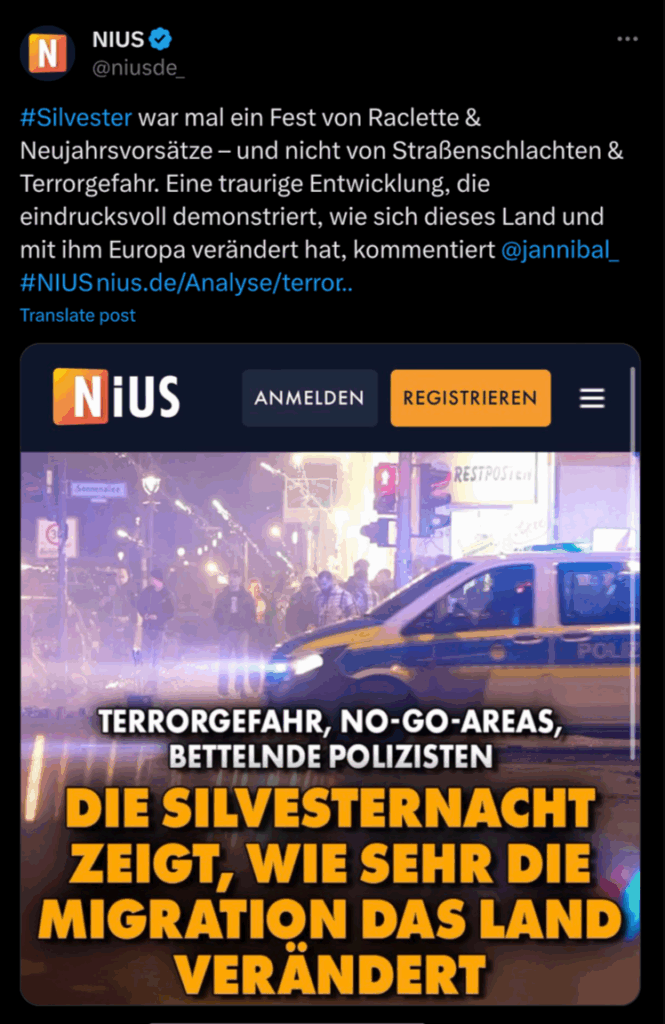
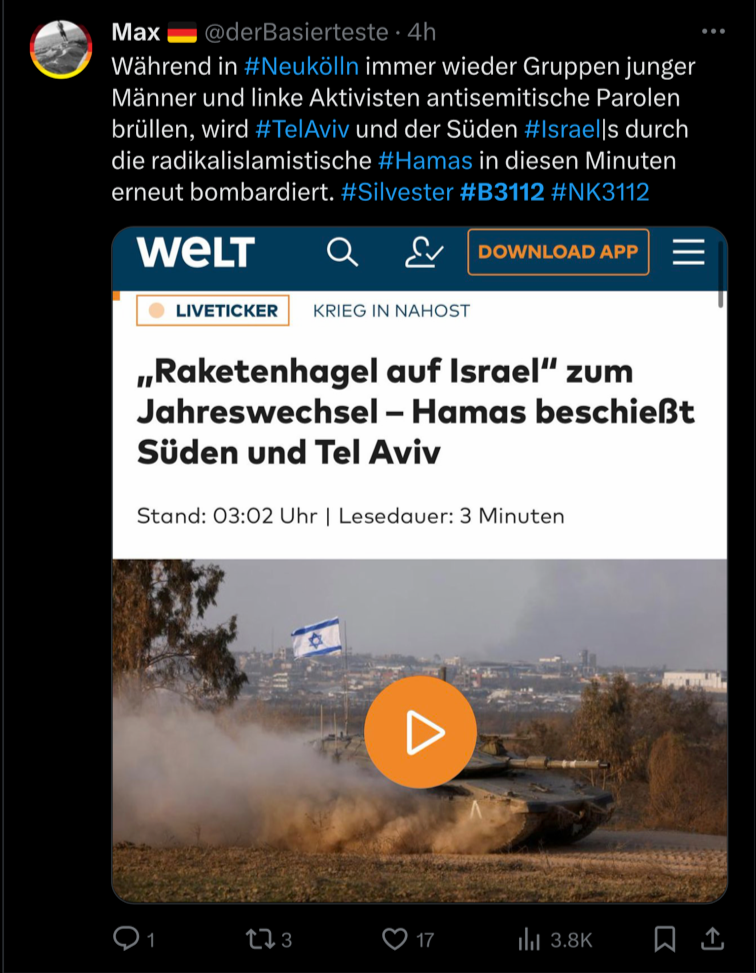
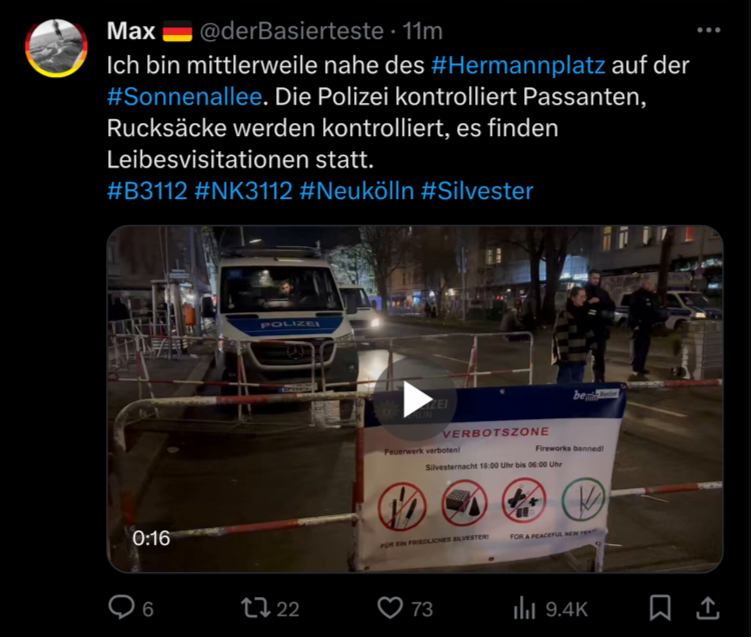
An example of quotidian applicability of this phantasm could be found surrounding New Year’s Eve 2023, which I followed on Twitter. Two months after October 7, the Hamas massacre and the following newspaper reports about alleged celebrations by its supposed sympathizers in Neukölln, Berlin was preparing for the New Year’s Eve celebrations. Neukölln became a hotspot due to media coverage and police presence. They established a firework-free zone neighborhood and installed checkpoints to control access to the neighborhood. In addition to NIUS’s1 relentless coverage of foreigners setting off illegal fireworks, Springer journalist Gerrit Seebald (@garstigergerrit) reported live from the scene. On Twitter, he prepared his audience for the state of emergency and posted a video of one of the checkpoints on December 31, 2023: “Access to Sonnenallee in Neukölln blocked. Police search everyone who wants to enter the firework-free zone. #B3112.” User Frisch Army (@Frisch630157) elaborated on the phantasm in a comment: “The Gaza Strip in the middle of Berlin.” The small border regime in Neukölln — fences, checkpoints, police presence, fear of riots and “Böllerterror” (terror fireworks) by Palestinian youths/Hamas — was immediately seized upon by Twitter users and interpreted according to the phantasm’s possibilities — Hamas, Gaza, terror is everywhere. Other actors took up the phantasmatic storyline: A right-wing video streamer named Max (@derbasierteste) broadcast live from the expected combat zone on Sonnenallee. In his live posts, published on X.com throughout the night of New Year’s Eve, he conjured up a war between Neukölln’s fans of Hamas and the German police. The parallels between Berlin and Israel/Gaza were plain to see for him as everything happened simultaneously, and he easily riffed on the mirrored relation of the two war zones:
“While groups of young men and left-wing activists repeatedly shout antisemitic slogans in Neukölln, TelAviv and southern Israel are once again being bombarded by the radical Islamist Hamas again at this very moment. #NewYear’sEve #B3112 #NK3112”
The bombs there were the fireworks here, and the hallucinatory game was vividly played out on Twitter. The scene “New Year’s Eve 2023” became available to many other users to exploit in phantasmatic imaginings. Thorsten Alsleben (@BerlinReporter) from the Initiative Neue Soziale Marktwirtschaft (INSM) posted a comment responding to the police-firework operation: “Little Gaza formerly known as Neukölln.” User Insulaner (@WurbsAndreas) escalated in another comment: “Berlin is going to be big Gaza. This is supported by the German Gouvernment [sic].” Berlin, or Neukölln, thus became Gaza 2, a place where, on the one hand, you’re trapped, and, on the other, terror reigns through migration, Hamas, etc. A Gaza of the Mind emerged, readymade to be fantasized about and collectively imagined by countless users, whether they were NIUS or Insulaner. The desire was so strong that people like Max@derbasierteste actually went to Sonnenallee to document with cell phones and streaming equipment what they wanted to see: Hamas coming in, the Berlin police, like the IDF, being forced to intervene to stop the terror of bombs and/or fireworks.
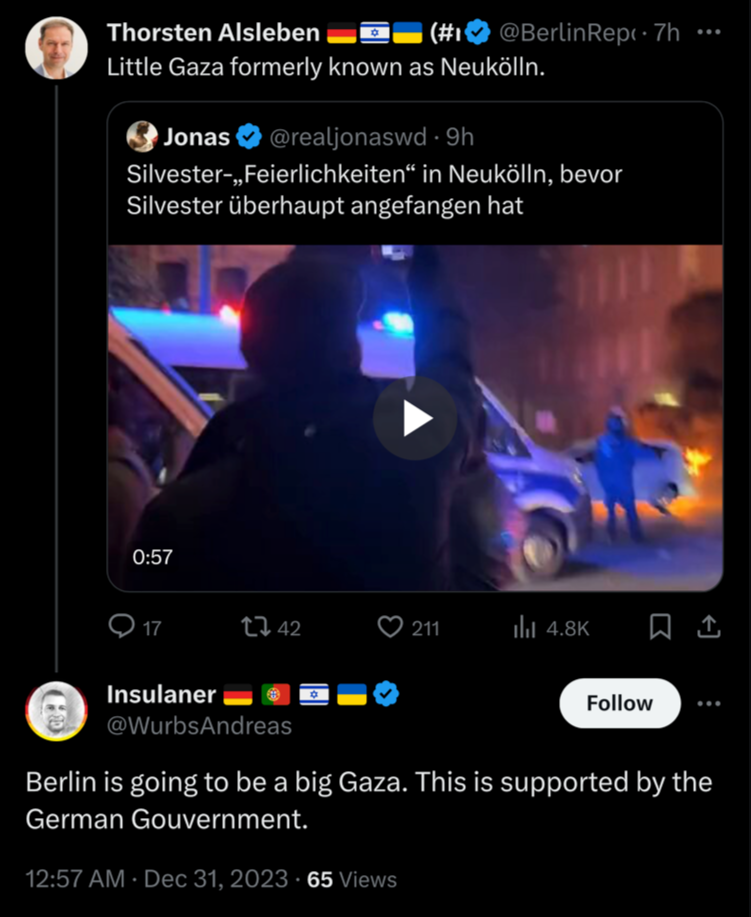
If Neukölln is Gaza, then Germany is Israel; if migrants are Hamas, then German police officers are the IDF; if migrants are antisemitic terrorists, then Germans are Israeli Jews, and so on.
Hundreds of tweets like these spell out what was already implied in police cordons, passport controls, and public suspicion since October 7, 2023: that Neukölln is a sealed-off or soon-to-be-sealed-off space in which different conditions apply and different measures must be taken — a Gaza 2, an open-air prison, a haven of Islamist terrorists wielding New Year’s Eve fireworks. This phantasmatic space offered numerous possibilities for further identifications: If Neukölln is Gaza, then Germany is Israel; if migrants are Hamas, then German police officers are the IDF; if migrants are antisemitic terrorists, then Germans are Israeli Jews, and so on. There were and there are endless ways of interpreting the situation on New Year’s Eve — the clash between police and youth, between Germans and migrants — along the lines of the “New Gaza” phantasm and use it for one’s own political or Twitter project.
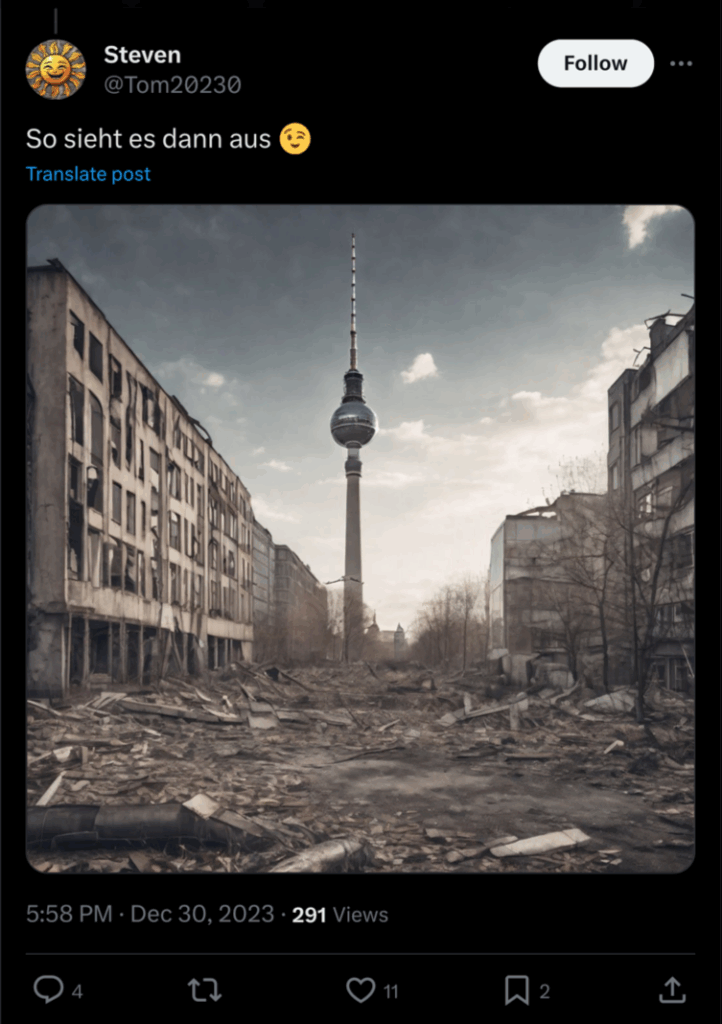
Twitter users conjured events, measures, or circumstances with AI or memes: a street lies in ruins, behind it the television tower; a memetic rendering of Neukölln superimposed with Mordor from The Lord of the Rings. These images and tweets are ambiguous, multipurpose: They can represent what one expects — Berlin lies in ruins — what one desires — Neukölln should lie in ruins — or what one remembers — Berlin was once in ruins, now it is again. One can mythologize the phantasm and describe “police against Palestinians in Neukölln/Gaza” as the battle for Middle Earth. The police are Tolkien’s Riders of Rohan, and migrant Neukölln with its phantasmatic Hamas is Mordor. These disavowals of reality also exhibit the often funny memetic behavior people engage in everyday on social media, e.g. in their attempts to block out the realities of genocide and German racism, to make fun of it, or to reject the reality of a war of retaliation and a racist surveillance state as a whole.
Twitter user Nasnspray@RonnyOhl2 used the Neukölln/Gaza phantasm in such an ambivalent way: under the headline “Berlin Neukölln 01.01.2024,” he posted a photograph of destroyed houses in the northern Gaza Strip, which was published in The Guardian in November 2023. Perhaps it was a satirical exaggeration of NIUS’s agitation, an exaggerated spelling out of the phantasm in order to ridicule it. Perhaps the post articulated a desire for destruction in Gaza to become destruction in Berlin. In any case however, the post very manifestly processes and rejects the real images of mass destruction coming out of Gaza — it enacts their derealization and disavowal while simultaneously registering and acknowledging them. This is what these posts say: Destruction is happening (or should be happening) right here and right now, and at the same time in another world.

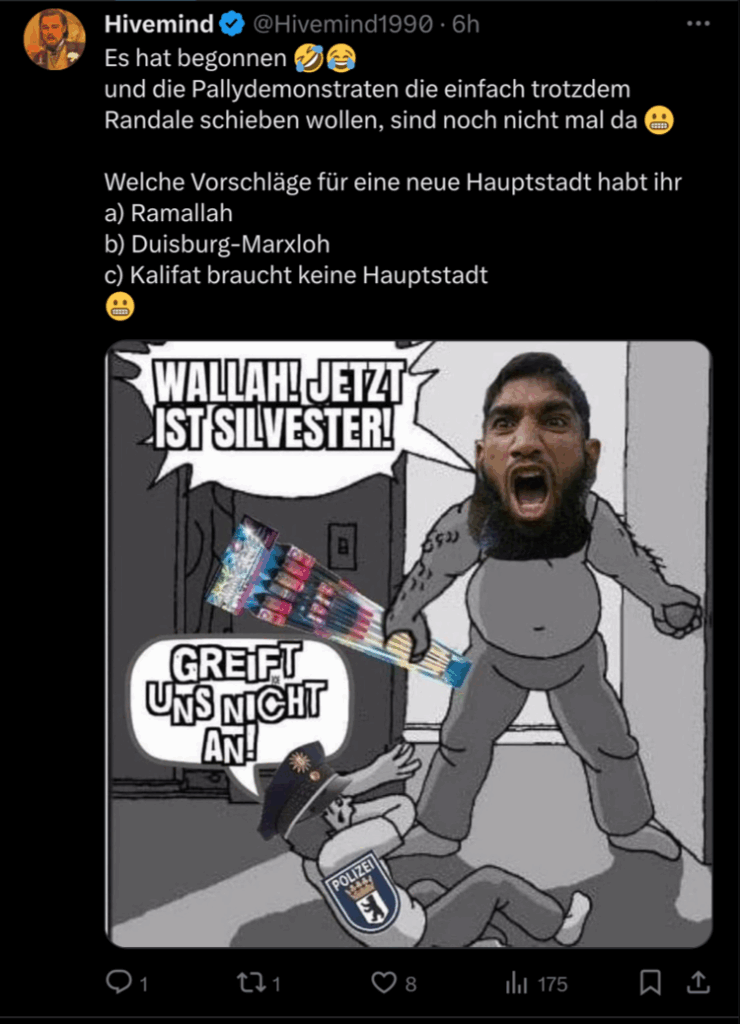
The meme-process “Imagine Hamas coming in here” or “Neukölln is little Gaza” is phantasm as everyday activity. It has high use value in politics, public discourse, and the media. The phantasm helps “to be OK with genocide,” as was said at the conference in Zurich. To talk about this phantasm and its many users is not “left-wing conspiracy theory,” as the NZZ described this contribution to the conference Rise and Fall of the BRD. To talk about the phantasm is an approach to the subterranean worlds of imagination (at work in Poschardt and others) that currently help determine what is done, decided, and generally perceived in the above-ground of the BRD.
Related articles

- NIUS is a right-wing online news platform, known for its anti-migrant and pro-AfD output [↩]