Never Again Good, Never Again Rich, Never Again Safe
Translated from the German by Damien Laing
In psychology, experiencing a sense of futurelessness is a symptom of depression. Those who are unable to imagine a future worth living experience a crisis in the present. Those who lack the tools to overcome their crisis face a future that appears bleak. One should be careful not to psychologize nations too much. Affixing them with a state of mind runs the risk of reproducing nationalistic thought instead of analyzing it. However, it is remarkable that across the political spectrum in Germany, different narratives of downturn or even potential downfall can be observed, and barely any expectation of a livable future. Is anxiety about the future the unifying element in social polarization?
If you want to address social anxiety about the future, it’s best to start by describing this future honestly, by giving it a name. Only then can you act reasonably without losing yourself in anxious fantasies. I share the theme given by this conference on the rise and fall of the Federal Republic of Germany (BRD). I find it fascinating to examine the theme of decline. For too long, it has been occupied — at least since Oswald Spengler and Armin Mohler — by the right. I would like to reclaim the topic for all those to the left of the crumbling center, and, actually, why not for the center too. There is potential for integration here. After all, nearly everyone needs to take the Deutsche Bahn at some point.
It may be that the Federal Republic completed its long journey west at the moment of the West’s decline.
We should, however, not reproduce the mistakes of German political debates or engage in navel-gazing. Because the relative demise of the BRD is not a German sonderweg. It may be that the Federal Republic completed its long journey west at the moment of the West’s decline.
This is the tectonic shift on which most of the current political debates in the German Republic take place. It’s possible to speak of alternatives, of a world after the West, of multipolarization, or the re-centering of Asia. Among these worldviews, although the accent may be placed differently, they all point in the same direction: namely, the relative decline of the West after a few centuries of domination. Pankaj Mishra suggests that another concept for the present is decolonization. Today, perhaps, we are experiencing a second great moment of decolonization after the Second World War. This is not only economic, but is also a political and symbolic, a mental and cultural shaking off of the Western hold over the world. This isn’t necessarily only good. Anti-colonialism is often viewed as progressive, but beneath the domination that is cast-off, the appeal to what is supposed to be one’s own and pure can conceal the repressive. The nationalism of rising powers doesn’t necessarily offer something better than that which has just passed.
To return to the conference theme, I would like to address this fear of Western decline through the vocabulary of the Federal Republic, with three forms of Nie Wieder, or “never again”: never again good, never again rich, never again safe. In other words, we find ourselves in a triple crisis of becoming good again, of becoming rich again, and becoming safe again. With the help of this vocabulary, we can succinctly describe the rise and fall of the BRD since 1945. Clearly, such a history can only be sketched out here.
Never again good
The moral rehabilitation of Germany is closely tied to societal reckoning with the Nazi past beginning 1968, alongside earlier state policies of reparations and those towards Israel. The policy supporting the newly-formed State of Israel, encapsulated in the forceful word Wiedergutmachung (literally “making good again”), was comprised of three forms of assistance: industrial aid through the reparations deal of 1952, arms deliveries prior to the Six-Day War of 1967, and financial support throughout the same period. In return for this decisive support, post-war Germany received an outstretched hand, which the Israeli government, even against the will of its own people, saw as necessary in order to secure the establishment of its fragile new state.
At the historical core of German-Israeli politics is the German wish for rehabilitation in the eyes of the Western bloc during the Cold War. In a post-Western world, however, it’s not possible to support the destruction of Gaza and expect to emerge with a reputation unharmed.
In the years after the Cold War, German policy toward Israel became even more tightly intertwined with memory politics in the name of Staatsräson as declared by Angela Merkel. Germany’s closeness with Israel expressed the distance from its own past. Under the banner of Staatsräson, the Federal Republic also participated in the destruction of Gaza by supplying weapons, diplomacy and moral cover, though here they travelled in the wake of America’s former administration under Joe Biden. At the historical core of German-Israeli politics is the German wish for rehabilitation in the eyes of the Western bloc during the Cold War. In a post-Western world, however, it’s not possible to support the destruction of Gaza and expect to emerge with a reputation unharmed.
Never again rich
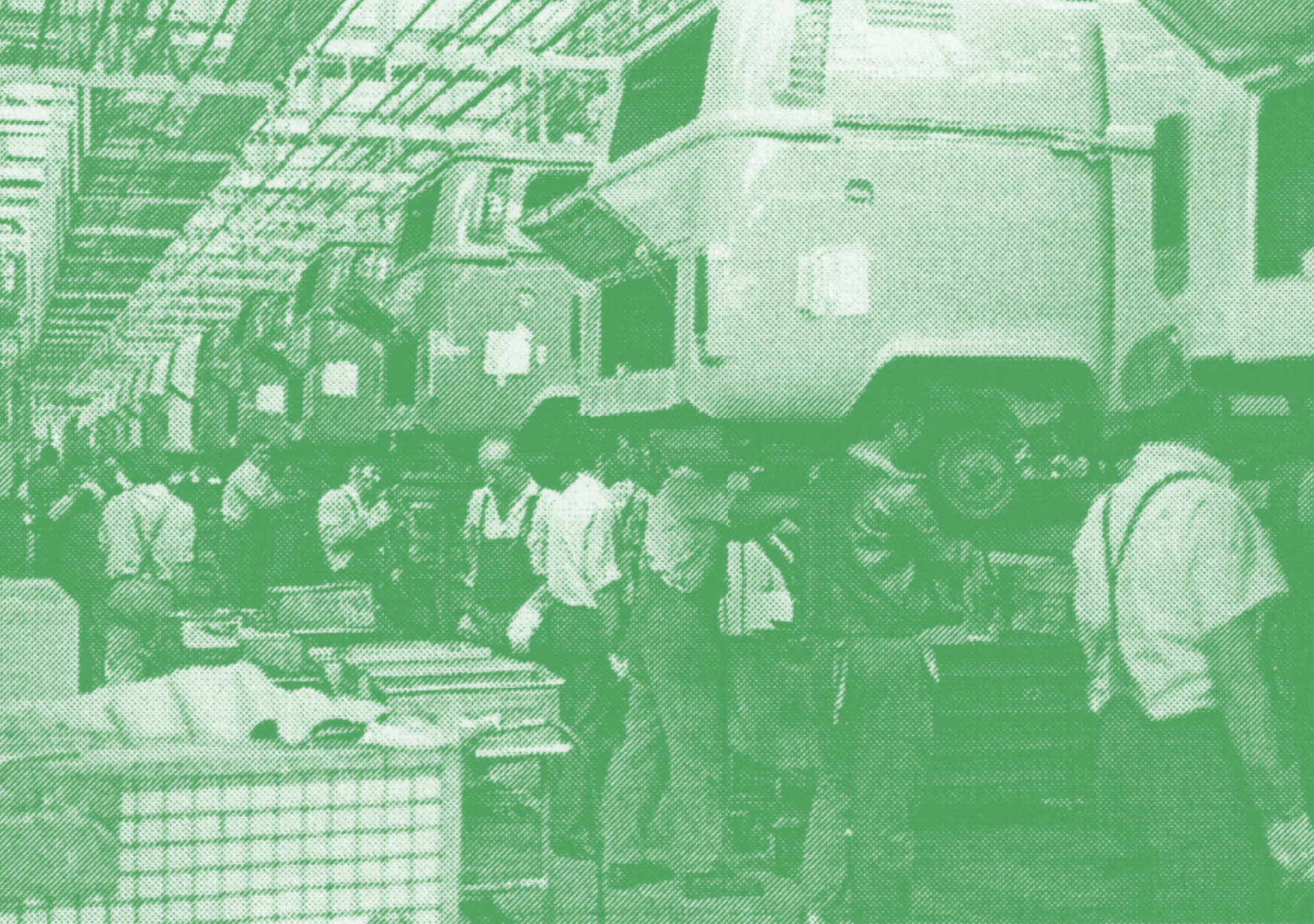
In May 2024, the Financial Times reported that the Chinese company BYD had overtaken Volkswagen (VW) as the preferred car maker in China. This is interesting for multiple reasons. The history of Germany’s comeback after the Second World War can be written from the perspective of the car, just as China’s industrialization (and with it the history of the German-Chinese relationship in general) can. But now, this history has been turned on its head.
While Chinese firms had previously required technology partnerships to learn from German manufacturers, now a company like VW hopes to learn from Chinese competitors to avoid losing touch with the future. That Chinese cars are bought in China is only partially related to patriotism. Electrical vehicles from BYD and other domestic manufacturers are cheaper and better, particularly in digital technology, and simply can’t be compared to offerings from German manufacturers.
What was once only heard from the margins of the political spectrum — namely that Germany was less sovereign than it took itself to be in foreign policy and national security spectrum — has now, due to Donald Trump, become the majority opinion overnight.
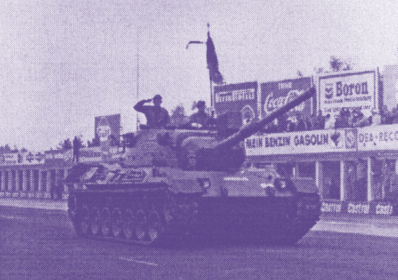
As a consequence, in 2024, VW announced the closure of factories, for the first time in the company’s history, which began in 1934 as a Nazi prestige project and was later a motor of Germany’s resurgence as an industrial power. Another traditional German company came to their aid. Rheinmetall AG offered to convert the mothballed VW factories to produce weapons. VW was open to the suggestion. So soon it may be that tanks rather than cars will be rolling off the production line at the Rheinmetall factory in Osnabrück. This is an economic alternative for the countries that can no longer keep pace in the technological race: the production of traditional arms like tanks and ammunition.
Never again safe
After the reelection of Donald Trump in the fall of 2024, the German public was shocked. The end of the West was proclaimed, at least in the form that we knew it. The German Chancellor Fredrich Merz, elected a few months after Trump, declared in the traditional post-election Elefantenrunde debate that the time of foreign policy dependence on the United States had ended. For a moment, the sworn transatlanticist sounded like the French General Charles de Gaulle, who very early had demanded an independent geopolitical role for post-war Europe.
What was once only heard from the margins of the political spectrum — namely that Germany was less sovereign than it took itself to be in foreign policy and national security spectrum — has now, due to Donald Trump, become the majority opinion overnight.
In fact, the foreign policy analysis of the traditional left has actually prevailed, yet they can derive no pleasure from it. That is because the objective condition of military subordination under the US was in the national interest of the BRD. Military integration with the West after 1945 meant not only increased sovereignty but also improved living conditions. As an issue, there is also the fact that the new American security strategy doesn’t identify China or Russia, as it usually does, but Europe as the ideological foe of the US, and threatens to support MAGA-friendly parties in Europe. Regime change in Europe through Trumpian declining imperialism? In comparison, the cheerful vassalage of yesterday was a historical stroke of luck.
Never again peace?
Moments of crisis can motivate action. The question is towards what end. The Federal Republic has left behind the fetish of balanced books and now takes out loans to invest in military equipment. But because investment in society is only allowed to be considered for the military, it makes clear the futurelessness and poverty of vision mentioned above. Maybe we will never be good again, never rich again rich, and never safe again. And possibly there will never again be peace either.