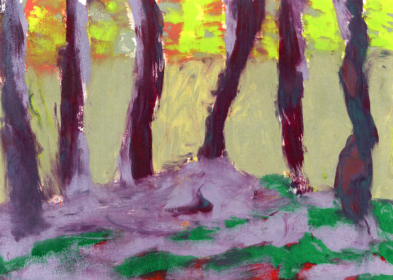
Not Ready for the Light
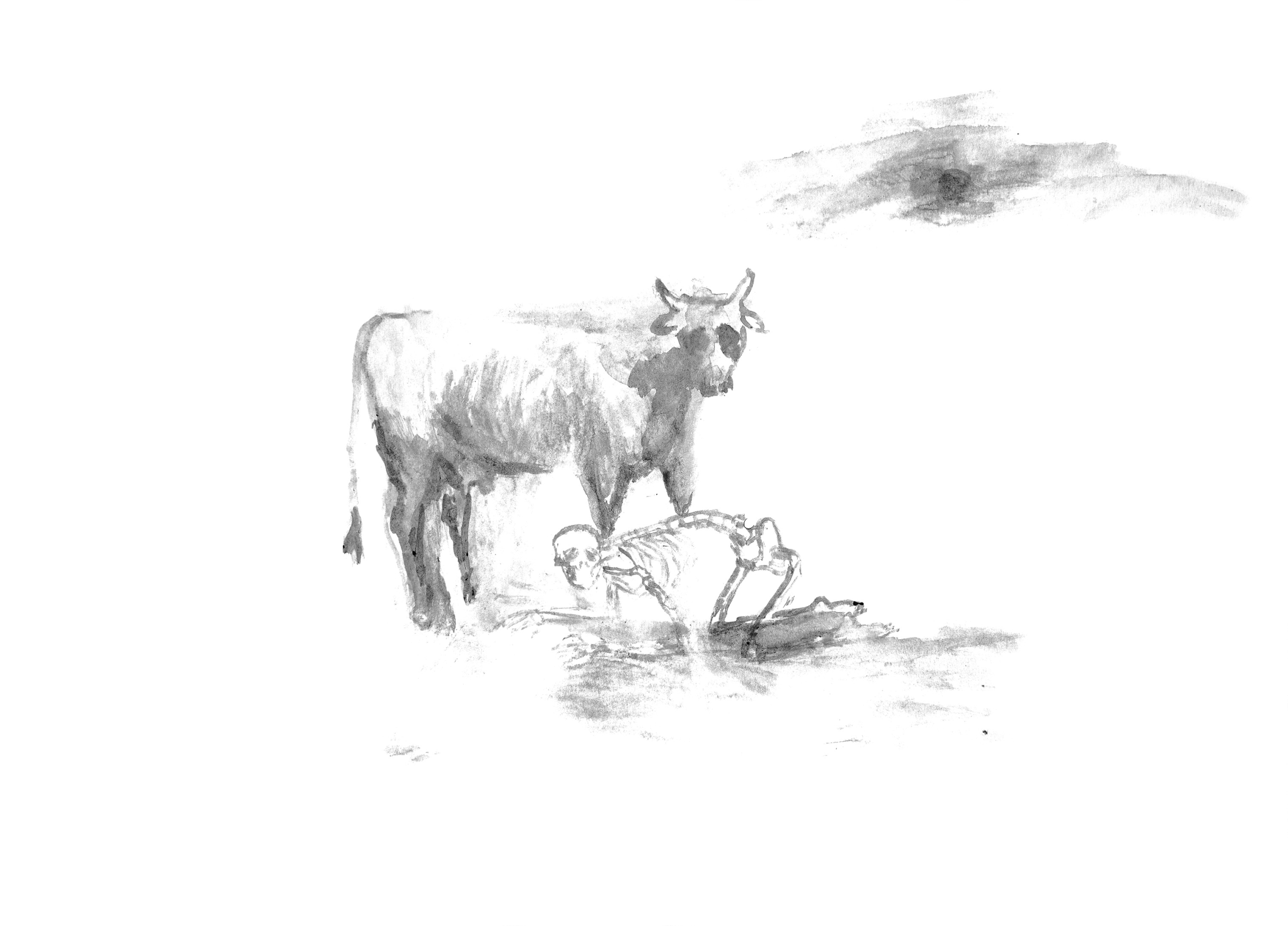
Every time before he was wounded, he dreamed it. The night before the 152-millimeter shell struck his position, R dreamed again:
He was back in his grandmother’s summer garden — the place of childhood safety, lilac bushes, and rusted swings. There stood a guardian gnome, one of those small painted figures that usually guard nothing.
In the dream the gnome started talking to him and pointed toward a freshly dug grave. When R looked closer, the grave had no bottom — it opened into a black hole. The gnome told him to jump in. R refused. “Not today,” he said. “I have things to do. You can wait.”
The next morning the shell hit the bunker directly. The blast caved in the roof, buried him alive under logs and soil. His comrade, by some act of impossible intuition, dug him out before he suffocated. His spine crushed, his body splintered by the wooden beams of the blindage.
The unconscious, unable to prevent the incoming shell, tries instead to represent it — to contain what cannot be contained.
He was evacuated to a field hospital, then to the central. Morphine entered his blood — at first as medicine, then as promise. Like Marianne Faithfull’s song “Sister Morphine,” the line between healing and disappearance blurred.
Later, when he told me this dream, I heard it not as prophecy but as the psyche’s rehearsal of annihilation. Dreams like these visit many soldiers: anticipatory phantasies that stage death in the space of sleep, so the waking body can keep moving. The unconscious, unable to prevent the incoming shell, tries instead to represent it — to contain what cannot be contained.
In psychoanalytic language, sleeping and dreaming are two different processes. Sleeping is the nightly work of keeping the psyche intact, re-charging the body. Dreaming, as Freud describes it, is a psychic function that protects sleep from desires and fears which are almost never at rest, those which try to wake us up, interrupting the charging process. So the psyche comes up with a solution in the form of dreamwork — constant symbolization of the raw material of the unconscious into images, stories, fragments of meaning. Thus the gnome performs the role of a psychopomp — a figure of transition—marking the moment when the dream-work protects sleep-work — metabolizing terror when the body cannot rest.
The dream above was shared with me by a client — a soldier of the Armed Forces of Ukraine — with whom I began psychoanalytic psychotherapy in early 2023.
A year and a half into our work, R brought another dream.
He was sitting among the ruins of a mikrorayon — one of those Soviet-era residential suburbs made of identical panel buildings arranged around a small communal courtyard. In the middle stood a children’s playground: a sandpit, a bent slide, the skeleton of a swing. It was somewhere in the east of Ukraine — one of those cities you only hear about in the news, somewhere near the frontline.
It was where a generation, raised under an empire disguised as communism, first learned what “we” meant. The “we” now fractured into the we who are still there and the we who left.
In his dream R was sitting on a bench in a children’s playground, surrounded by half-destroyed apartment blocks. Everything was in black and white, silent, devoid of life.
He suddenly felt the need to call me. He reached for his phone, which was in the right pocket of his pants. But when he tried to pull it out, he realized that all five fingers on his hand were broken. They were there, but they would not respond — as if they no longer obeyed him. The darkness around him thickened as he tried desperately to dial my number.
Then, all at once, a thin line of light appeared — a clear, horizontal incision. He felt compelled to cross it. On the other side was Khreshchatyk Street in central Kyiv, flooded with sun and color, a day of celebration: families walking, women with flowers, children laughing.
While standing there, he looked down and saw his clothes — filthy, stiff from blood and earth from the trenches. The smell of smoke and decay clung to him. The light around him was blinding, almost accusatory. He understood that he didn’t belong to this brightness, it exposed rather than welcomed him. And then he felt it — the gravity of the dark, familiar, heavy — pulling him back toward it.
He made his choice and stepped back into the dark, finding himself once more at the ruined playground, trying again, with his broken fingers, to dial my number.
That’s when he woke up.
The psyche withdraws from exposure the way a wound closes against air — the temporary darkness is needed to keep healing possible.
When R told me this dream, I kept returning to the place itself. The playground in the center of a mikrorayon — ringed by those uniform Soviet panel blocks — was once part of an architecture of belonging, an image that united generations.
Now, in his dream, that space appears in monochrome: no light, no color, only gradations of ash. The collective space has survived, but only as a photographic negative of itself, remaining in the darkroom of the psyche, still wet, still trembling, not yet ready to be developed. Not ready for the light.
For me, such rejection of light is not a negative regression but preservation. The psyche withdraws from exposure the way a wound closes against air — the temporary darkness is needed to keep healing possible.
This is what I see, again and again, in those who cannot sleep, or who cannot wake fully, or who have left — not an avoidance of life, but a strange kind of loyalty to it. Some part of the organism knows it has to pull back before carrying on.
In the 1970s, two Chilean biologists, Humberto Maturana and Francisco Varela, offered a language for this movement. They called it autopoiesis — from the Greek auto, self, and poiein, to make. A living system, they wrote, exists not because of the matter that composes it but because of the continuous work through which it repairs itself. A cell stays alive only by renewing the membrane that separates it from what might dissolve it.
But this logic of self-making belongs not only to cells. Rivers live by it too. They withdraw from their own banks, erode them, redraw them — always producing the shape that keeps them alive. When the current becomes too strong, the river folds, pulls inward, digs a new path through silt and shadow. It does not abandon its course; it remakes it. I often think the psyche works the same way. When the environment turns toxic, it retreats just enough to continue its flow.
That is what I see in the dreams of soldiers — not prophecy, not mysticism, but a desperate maintenance of being, an invisible repair that happens in the dark, where the psyche rehearses its own demise.
Both sleeping and leaving are, in their own ways, small and large versions of the same movement — allowing the regeneration of the self, a temporary retreat that makes survival possible.
When sleep fails — as it so often does in war — the mental system stays open to the bombardment, both literal and psychic, until it begins to collapse. That is what I see in the dreams of soldiers — not prophecy, not mysticism, but a desperate maintenance of being, an invisible repair that happens in the dark, where the psyche rehearses its own demise.
Leaving follows a similar logic, only on another scale. It is not exile in the classical or tragic sense, not ‘nostos’ — the longing to return home — but something closer to a macro-sleep. It is the psyche’s way of dimming the light when the exposure to reality grows unbearable. Those who leave Ukraine, or any place of catastrophe, do not step away from belonging, but from both physical and psychic annihilation. To depart is just another way to preserve the ability to feel.
Sleep, leaving, silence are the pauses through which reality becomes thinkable again. They are the psyche’s slow acts of autopoiesis, the work of re-creating a boundary, of saying softly: I am still here, even if for now I must stay in the dark.
At the same time, every drone video, every televised frontline, every ruined building demands to be seen. But psychic life works differently, it cannot survive while constantly exposed. It needs opacity, latency, and the off-frame. It might seem as the rage against the light, the negation of truth, I see it as hibernation, the condition for meaning to return.
Even in the dark, memory continues to develop. One just needs to find a way to wake, to dream, to keep dialing a number.
This text is excerpted from Notes on Living: Reflections on Ukraine Today, edited by Max Eulitz and published by Spector Books in 2026.